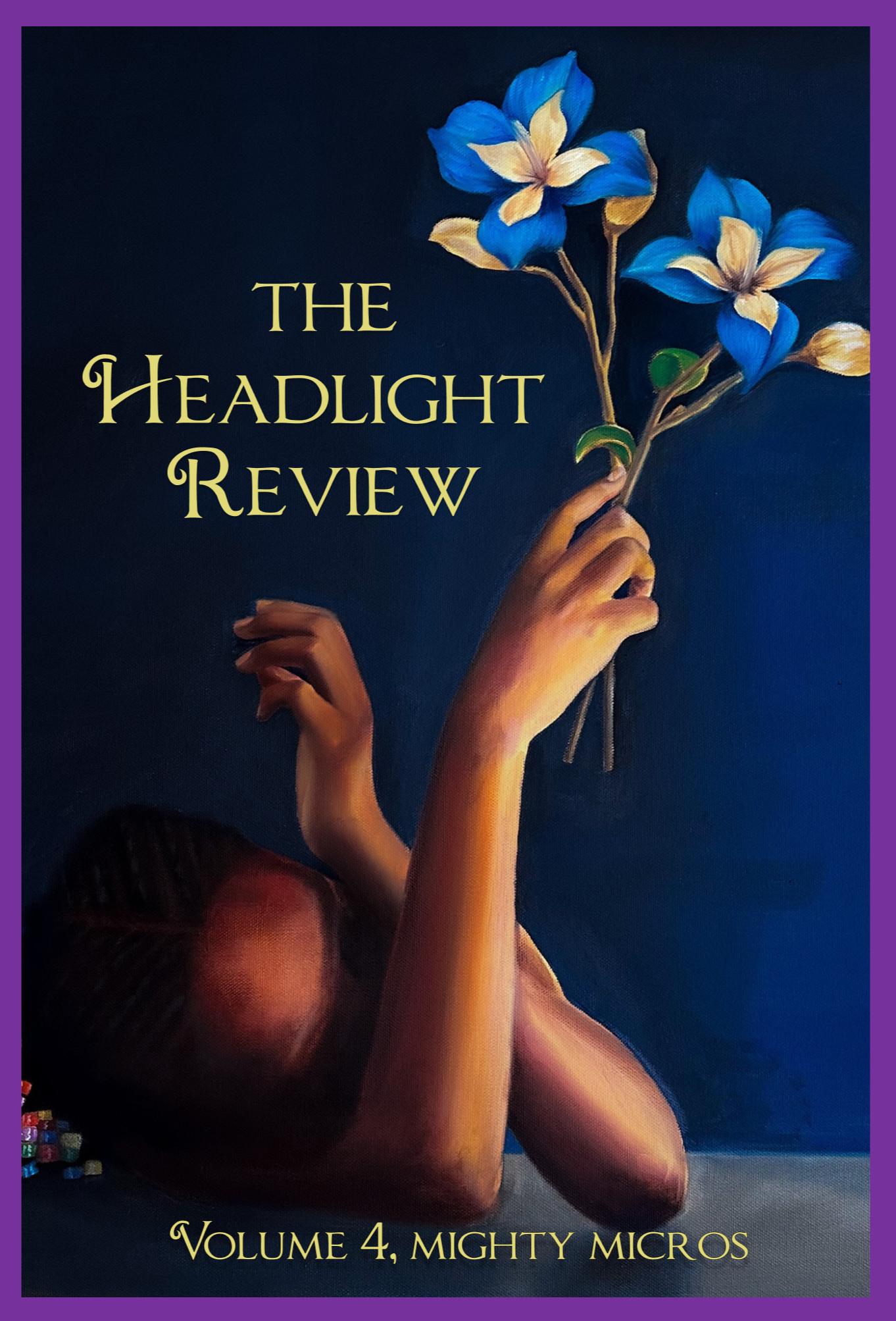
[[bpstrwcotob]]
My Bio
I was born without breathing and placed in a small hand-painted basket, oxygen cupped over my fragile mouth.
I was born without breathing and placed in a small hand-painted basket, oxygen cupped over my fragile mouth. Actually, I was gingerly put in a cardboard box. I always wished it had been a basket. I remember it smelled faintly of grove oranges and coriander. Though my mother told me it was recycled from a case of champagne that was popped on New Year’s Eve, four months and one day before my May Day arrival.
How does it feel to weigh the same as a rabbit? I remember. It was exhilarating and terrifying all at once. My legs felt small and powerful even though my bones were soft and still molding. I had a light dander that I had hoped would morph into a full-fledged warming fur. My nose was crinkled and acute. My eyes sealed shut, thank goodness, as I was unable to see the monitors and fluorescent lights, all which would have brought me back towards the collapsing womb.
And then there is a very long gap. I don’t recall. Or maybe I blocked it out. I found myself with a man I’d been with for more than a decade. Almost two. From rabbit to him. Yes, there are flashbacks, memories that come to me:
I am a girl of ten and insist on wearing a paper bag over my head at home so my parents can’t see me.
I am in college dating a man who wants to watch me eat my own hair.
I am at my first job and my boss tells me every day my dress is see-through even after I start wearing a cement coat with galoshes and Coke-bottle glasses.
But then I am with this man for my whole life. Until now. He drives me over the Brooklyn Bridge. It wasn’t until after that he tossed me over. After we’d driven thousands of times, over years where we kept our own rabbits. A fluffle. Some angry. And jumpy. A few soft, and sweet. The rabbits were masters in role-play. One cashmere lop, with a particularly sultry mouth, wore a costume. I remember that. She was dressed as a sexy nurse.
Tomorrow, I will meet another man. One who wears a mask of mirrors, shards melded onto his face. When I stand too close, I will see myself through his dark energy, reflected and refracted. Cracked. With light coming through.
This piece was featured in Volume 4. Click here to explore other pieces from this issue.
Different Ways to Bathe
She’s of an age where a little something sometimes appears in her underpants.
She’s of an age where a little something sometimes appears in her underpants. Where did that come from? When? During second period industrial arts, the seventh-grade boys knocking chairs, talking back, making everything teeter? Then, front row, sweet Silas, near tears: “I can’t stand it when they disrespect a guest.” Little Bear, the woman’s heart purrs, don’t you worry. Inside her a tub fills. To a girl in dark curls she admits: “I thought I was signing up for robotics!” (Not miter saws, sanders, drill press. . .) Curl girl nods, “Me too.” They share a snort. The woman lets Silas fetch someone from the office. When a portly fellow marches in, an orange-hair lass sasses, “Havin’ trouble keeping your pants up?” He walkie- talkies for backup. Ironic that it’s orange-hair girl who gets pulled. Noon, when she leaves the school, the woman stops at the grocery for a small avocado and continues home for a butt bath (that odd bedpan-looking thing—thirty bucks well spent!). Over lunch her mind drifts back to something huge. Giving birth. Not her. But Becky. Who bestowed the biggest honor of the woman’s life. To accompany Becky of lioness black mane while she moaned, refused meds, huffed hot mama-bear breath, and in One Blood Curdling Scream popped a head and—sploosh—a whole new being amongst us. The perpetual brimming bucket of the scene spills through the woman in a fifteen-second rush. Shoulders, chest, tear ducts. She carries her glass to the kitchen and pads to a padded rocker. Washed, dried, wept, she takes a seat near Silas, the girls, the boys in back. One baby breath, two. Another. The next.
This piece was featured in Volume 4. Click here to explore other pieces from this issue.
Self-Portrait
I don’t want to go to the neurologist, but my family insists something is wrong because I am rhyming words and predicting the weather.
I don’t want to go to the neurologist, but my family insists something is wrong because I am rhyming words and predicting the weather. I knew my daughter-in-law would have an affair before my son because I watch Spanish soap operas, not for the Spanish lessons, but the expressions. Que lastima. What a pity my son is blindfolded to his wife’s wildness. I knew my husband would die without saying goodbye because he believed we would meet in the next life, but I know there is no afterlife, no meeting place where we can meet for a drink or two. I wish I could have told him nothing was as miraculous as that first day when he smiled at me and said I looked like Pocahontas. I wore braids then to keep my hair wavy, not curly. Now I let it just be curly. I let things be. The daughter-in-law. The son. The husband who won’t like my hairstyle. But he’s dead and, as I said, we are not meeting again. I know I repeat myself. But repetition is what makes certain songs stay in our minds. We repeat lyrics. Then find the words when we need to sing. I am singing now, but my family thinks I am off kilter, given to flights of fantasy, bereft of my marbles. I didn’t know they wanted a Betty Crocker mother who couldn’t carry a tune.
This piece was featured in Volume 4. Click here to explore other pieces from this issue.
Braids and the Meaning of Life
As a child, I was in awe of girls with braids. Girls whose hair was set in strictures like Sunday sermons.
As a child, I was in awe of girls with braids. Girls whose hair was set in strictures like Sunday sermons. I saw how hair could be parted in one quick stroke, the sharp bite of the comb moving down the scalp. How their braids lay thick as whips along their back. Even the coarsest hair could be mastered with toothy combs and tubes of gel. But I was a strubbly child. My hair stood out, defiant, headstrong. Uncontainable. I kept trying to learn the art of braiding with my dolly, twisting and turning two clumps of hair around each other―but I could never form a braid until I watched my friend’s mother separate her hair into three equal strands I could follow as they took turns winding over and under each other. So much of life, I found, is composed of three, like the primary states of matter. Even the pole star, it seems, is really three stars in one. Not to mention the three-person God I tried to divine at school. That strange family of men. Is it some stubbornness that makes me need a third proposition to defy life’s Either/Or? A theory like a braid, whose even coils I longed to feel, twining down the center of my back.
This piece was featured in Volume 4. Click here to explore other pieces from this issue.
Before the I-5, My Father Was Mexican
While attending a conference in San Diego, I am cooped up in a hotel that is coincidentally on the same street as my paternal family’s first home in America.
While attending a conference in San Diego, I am cooped up in a hotel that is coincidentally on the same street as my paternal family’s first home in America. I decide to look up the address because it will make me feel like I knew my father. 17—, I type into Google. An image of a faded yellow bungalow that sits beneath a billboard encircled by skyscrapers is the top search result. Immediately, I am reminded of the film Up. I scroll down the page, selecting a link that references historical resources.
An attempt was made recently to designate the surviving half of this community of bungalows as historically significant. The other half had been destroyed when the state sliced through the neighborhood to make way for Interstate 5 in the 1960s.
The report, which denies the request, reads:
There are hundreds of similar, or better, examples of Craftsman architecture…
Additionally, [the buildings] are not associated with historically significant persons or events
The report talks about the Italian community, but my family was Mexican, even though they later changed their last names to masquerade as Europeans and escape discriminatory attitudes.
not associated with historically significant persons or events
I consider the significance of my father, who looms large in my mind even though I refer to him in past tense when discussing him with others. My father was, my father would. Strangers must think he is dead, but really, he left my mother for a mistress and then left that mistress for another mistress and forgot he had a daughter.
Before I looked it up, I had imagined the house flattened, recalling the ending of the film Love & Mercy, when Brian Wilson of The Beach Boys goes back to his childhood home in Hawthorne to find it no longer exists. In a way, I am disappointed Dad’s home is still standing; it would have been a cleaner ending if it were gone.
I stare at the bungalow online and envisage myself being dropped off on the side of the busy road, knocking on the door, and announcing my entrance. My grandparents greeting me. My father not yet marred by my authoritarian grandfather. Who would he have been? I see him before the I-5, before he could remember the sound of heavy machinery severing the neighborhood, before his family claimed French heritage: when he was Mexican.
This piece was featured in Volume 4. Click here to explore other pieces from this issue.
God is a Catfish from the White River in Martin County, Indiana
God is a catfish from the White River in Martin County, Indiana and we would eat Him on Summer Sundays after Mass.
Him on Summer Sundays
after Mass. Sometimes
we would eat Him
on the lawn of His own house
as the sun shone through
the sycamore leaves,
creating its own stained
glass on the grass
beneath our feet. We named our
biggest county festival after Him,
the CATFISH FESTIVAL.
And we would walk up
and down the main street to
look at the vendors selling knives,
quartz figurines, and paintings
of the American West, even
though we were smack dab
in the middle of it. Up the road
is the bridge where men
fished for Him, the biggest
of the summer meant
bragging rights for the
year. Some would be
mounted, others were soon
fried and fed to those
finishing games of softball
in the park. When night came,
we would sit in a truck
bed or on the hood of a
car, still warm from
the July sun. The grease
from the feast of Him
earlier in the day still
on our fingertips and
lips. Around us,
fireworks of all kinds,
but towards the heavens was
where our eyes would
always end up. We would inch
our hands closer to each
other, in hopes that they would
meet. If even briefly, we would
live off that touch for
weeks. We would make plans
ourselves that this was
the rest of our lives. In the
morning, we would know what
we were going to eat that day.
This piece was featured in Volume 4. Click here to explore other pieces from this issue.
FDA APPROVED OPERA SERIA
The distorted face has always been her forte. The distorted face is the contrabassoon. I’m grimacing.
The distorted face has always been her forte. The distorted face is the contrabassoon. I’m grimacing. It always starts with the contrabassoon to tell you that something terrible may happen. Then the sobbing. That’s when the bandoneon starts to play. The weeping. That’s the two-string Chinese violin, the erhu. The wailing. That’s the clarinet. The striking whimpering, the shaking bawling, and the scraping blubbering are hitting my ears like percussion. I’m covering my ears but the bagpipes have already swallowed the ode to joy and left a suspended note instead. Every suspended note needs resolution.
My little sister is running her castanet feet through the black and white diamond-pattern carpet without respecting today’s odd day which is the fifteenth of the month, so it’s white diamonds only. The new conductor throws one of my maracas on a black zone of the diamond-pattern carpet. It breaks in half with a muffled sound. The maraca’s sandy vocal cords are lost in the caesura. I can’t touch the sand with the treble of my feet. The sand undergoes an involuntary register change. I have a gross shuddery out-of-tune feeling in my spine. Every suspended note needs resolution.
Sand is made of decomposed rocks like quartz (silica) and feldspar. There are roughly eight billion grains of sand per cubic meter of beach, and roughly seven hundred billion cubic meters of beach on Earth. That’s five sextillion grains of sand. That’s too much sand, even for sand-filled hammer shakers. It’s making my head spin like the egg beater spins when Mom mixes dead chicken fetuses to make pancakes that look like frisbees. Chickens like xylophones. My pyrophone is burning inside. The mobile musical safari reflects flickering lights. My insides are like burners in cylindrical glass tubes.
The Queen of the Night is about to throw the second maraca. My dad walks into the playroom with the risperidone and blows the French horn to call the hunting dog out of the woods. But it’s too late for severe sedation. The six-second rule does not apply to frenetic random activity periods. I already threw my sister out the window. Every suspended note needs resolution.
This piece was featured in Volume 4, Mighty Micros. Click here to explore other pieces from this issue.
Invocation
Kingsessing in Southwest Philadelphia is a low country of porches and brick. A long green edge where Cobbs Creek keeps the seasons and the city sets its weight down
Kingsessing in Southwest Philadelphia is a low country of porches and brick. A long green edge where Cobbs Creek keeps the seasons and the city sets its weight down. It is trolley bells and bus sighs, damp cellar air, snow that turns the street into a white ledger and summer that writes itself in hydrants. It is rowhouse cornices and hand-painted signs and the iron geometry of fire escapes. It is the smell of bread at dawn and hot brake pads at noon and rain lifting the dust off asphalt in the evening. Kingsessing is corner glass and barber mirrors, a library cool as a sanctuary, a ball thudding on varnished wood, a church basement that knows fifty recipes for mercy. It is stoops—the first step, the second step, the last—with chairs set out like commandments and gossip folded small as a prayer. It is aunties with sun hats and boys with scabbed knees and girls with jump ropes thwacking time. It is names printed on envelopes and on shirts and on the backs of jerseys, and it is the other names, the ones you earn: Ms., Coach, Cuz, Deacon, Nurse. It is the slow code of nods on a morning sidewalk. It is the place under the El where the pigeons keep their own parliament. It is a crossing guard’s raised palm and a bus kneeling and a driver who waits longer than he has to. Kingsessing is a rulebook and a rumor and a promise made on the corner; it is a notice taped to a door and a hand that takes the tape down. It is rent due, and it is someone sliding an envelope across a table, and it is thanks left like change on the table. It is the long light on Baltimore Avenue and the straight run of 52nd where commerce speaks in neon, with half the letters missing. And Kingsessing is its people, which is to say it is the sound they make together when a siren passes and no one you love is in it. It is the patience at a red light when the street is empty. It is the small work of keeping: a sweep, a saltshaker, a knock, a name. It is a neighborhood that outlasts its weather, and it is the weather that teaches the neighborhood how.
This piece was featured in Volume 4. Click here to explore other pieces from this issue.
Morels
You can’t find morels without your father’s eye trawling the deadwood and bramble for you. Thrashers thrash in the canopy, busking their duplicitous song while chipmunk and squirrel weasel through foliage, striped firecrackers.
You can’t find morels without your father’s eye trawling the deadwood and bramble for you. Thrashers thrash in the canopy, busking their duplicitous song while chipmunk and squirrel weasel through foliage, striped firecrackers. A tree has fallen across the path you and your father carved out three years ago, back when he could lift the chainsaw without shaking. Today, he holds only a bucket and won’t let you carry it, though you know his left side is numb. The Laetiporus on the tree trunk is orange but unripe, and the puffballs you saw near the rusted, stripped Camry a hundred feet back are bloated with spores, too mature for the butter and garlic baptism you would have given them at supper. Summer and Fall battle over the maples’ chlorophyll, but the trees’ shadows do not change. Your father says this is the week for morels, so you must help him harvest before the mosquitoes die and the ticks vanish. Before the longlegs curl up dead and the hummingbirds depart and the wasps slumber in their paper nests and before he shakes too much to hold anything at all, even a bucket. He still hasn’t told you how to identify morels. You don’t know how you’ll find them when he’s gone.
When the Veil is Open
You can’t find morels without your father’s eye trawling the deadwood and bramble for you. Thrashers thrash in the canopy, busking their duplicitous song while chipmunk and squirrel weasel through foliage, striped firecrackers.
Before the web, there was the web of connection, no endless moving trains of news, global distractions, or any sounds all day and night. I remember the silent wind with my mate at age nine on bicycles along Suffolk roads between house paths, on country tractor paths, mooing at dairy cows we passed. I looped a plastic sack around handlebars with two potato-crisp sandwiches, prawn cocktail flavour, crushed well between caked-bread slices, with a Cadbury Flake for afters. I didn’t know what a spirit was, a duppy, or any spirit at Salvation Army or Cub Scout meetings, as I do now. Wondering if King Solomon did enough to imprison the demons and gins. In a house, a darkened room packed with friends and family, dutty-wine-dancing, filled with gin and rum, while us kids were distant, checked in and out of the coat room. Did the lovers rock, heavy reggae bass-tones, the grown-folk groove, tear the veil as Gnawa Guembri to those beyond? If I discerned enough—could I see wandering duppies bring us closer, tighter as the drink-mix loosened bones within. Each soul here, hips and groin, gyrated with deep-dropping bass and drumbeats, dripping skin with sweat. Bodies open and release in the beguiled state, my breath empty. I wonder which crows or blackbirds were watching us back then, hidden in the darkness beyond our windows or in the morning blazing sun. Ancestors on power wires, brick pub corners, or the magpies in my yard, presently watching me as I see them. Ancestors appear more in the Spring, collecting souls, bargaining lost hope broken-glass with the gins, not during the stale-tree stick-life loneliness of Winter. Maybe that’s why there is so much silence in the palatinate forest, before buds open, sails of swishing leaves begin, before the woodpecker is pecking a new home, or releasing Morse code warning to those awakening in their seasonal rebirth. This woodland place where webs were frosted statues, thawing out their connection to each beech tree, oak tree, without the noise humans created, recalling the stillness where we once played, where we once began.
This piece was featured in Volume 4. Click here to explore other pieces from this issue.