How Long Ago Was This?
This essay is part of an occasional series of "Refractions," where readers reflect, respond, and recommend writing that speaks to our place and time. To propose a "Refraction" contact the editors at headlightreview@gmail.com.
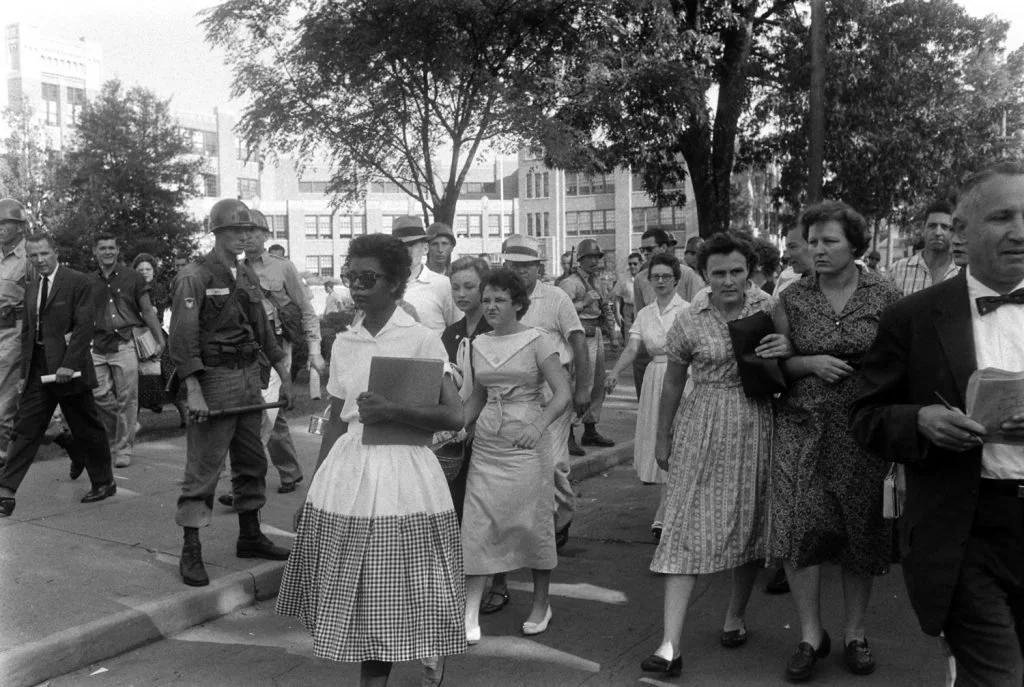
The National Guard refuse Hazel Bryant entry into Little Rock’s Central High, Arkansas (1957) [Francis Miller/Life Pictures]
Recently, I had dinner at a Midwestern Cracker Barrel. This was on a snowy evening in late December. I’d been sitting in my motel room all afternoon watching a bowl game between Tulane and Ole Miss. I’d made a bet on Tulane, who lost 41–10, that was one thing. At commercial breaks were political ads where a Republican candidate campaigned strictly on his support of Donald Trump. Over and over were played clips of when Trump had mentioned the candidate’s name because he was a fan of the president’s.
The candidate was promising to be nothing more than a hollowed-out vessel, which of course is the only thing the president demanded. Who runs for office solely on the promise of doing everything someone else says? No new ideas, no different solutions.
And I thought, The people in this community can’t see this charade?
I hadn’t been having a great day. I’d sailed into town that morning, hoping to surprise old friends, see if they felt like tearing it up, blast Lou Reed albums all night, at least until the cops came. I found out that not only had my friends moved, the people living in the house now couldn’t recall anything about them at all.
They asked, How long ago was this?
I said, I guess I lost track. It was the only response I could think of.
Once I was seated at the Cracker Barrel, my mood improved. The server was a polite young guy, maybe college aged or even younger, and he checked on my tea every few minutes. All the servers were like that: young energetic, enthusiastic, polite. He recommended some type of country-fried turkey dish, and I said, Fine, let’s go with that. I noticed the other customers, who were of all ages, and the general pleasantness of the dining area. People getting good food at a (fairly) square price. I’d grown up in Kentucky and could never remember having a bad dinner at a Cracker Barrel.
My thoughts moved around, returned to those political ads. How someone wanted to run purely on the coattails of someone else, and that someone else was of the lowest quality a man can be. I thought about the candidate running the ads, and all that hadn’t been said in them.
A poem by Gwendolyn Brooks came to me. “The Chicago Defender Sends a Man to Little Rock.” I jolted in my seat at a possible connection. Brooks’s poem was written in response to the integration of Central High School in Little Rock, Arkansas, in 1957. In the poem, the Defender sends a reporter to Little Rock to find out what on earth was wrong with the folks of Little Rock and how they could be so abusive and terrible to young students because of their skin color.
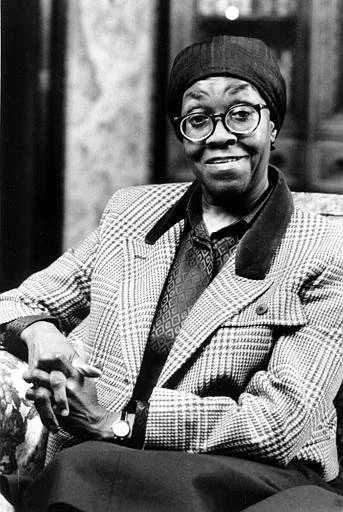
Gwendolyn Brooks (Associated Press)
What did the reporter find out?
In Little Rock the people sing
Sunday hymns like anything,
Through Sunday pomp and polishing.
And after testament and tunes,
Some soften Sunday afternoons
With lemon tea and Lorna Doones.
I finished my meal. Back in my room, before the start of the next bowl game, I went to my email to see the last time I’d heard from my friends who lived in this town.
I thought of a party I’d been to in that house. Good lord. In my defense, I’ll say that Lou Reed’s stuff is timeless, a lot of it, anyway. Artists can do that, put their finger on something that keeps on being true, even if it’s a truth that’s hard to accept. I thought of a line from Reed’s “What’s Good”: I’ve been around, I know what makes things run.
For whatever reason, I couldn’t get interested in the bowl game that night. A blowout, two mismatched teams. More political ads. I wound up opening the curtains and watching the snow fall.
In the morning, when I pulled the curtains back, the white covered everything.
I felt like heading home, getting back to Atlanta.
The room had a mini coffee maker and while I waited for my cup to brew, I looked up more on the Little Rock Nine, the iron-willed teenagers who’d integrated the high school. Their names: Minnijean Brown, Elizabeth Eckford, Ernest Green, Thelma Mothershed (Wair), Melba Pattillo (Beals), Gloria Ray (Karlmark), Terrence Roberts, Jefferson Thomas, Carlotta Walls (LaNier).
I also read that in 1958 the Arkansas Gazette received a Pulitzer Prize for their editorials about the crisis. Editor Harry Ashmore covered how then–Arkansas governor Orval Faubus brought in the National Guard to prevent the Black students from entering the high school. The series began with an op-ed titled “The Crisis Mr. Faubus Made.” Ashmore wrote that the governor wanted to intensify the chaos in order to gain support with white voters.
It was time to pack up, get moving. The coffee might’ve been complimentary, but it tasted like a struck match.