

[[bpstrwcotob]]

Love Song Intended to Stave Off Discontinuation of Relations (Unsuccessful)
I’ll be your boy toy!
Say you want me
And I’ll be your boy toy
If you want me hard to get
I’ll be your coy boy toy
If you want me Scottish
I’ll be your Rob Roy boy toy
If you want me to swell and sway with the crowd
I’ll be your hoi polloi boy toy
If you want me strong like copper and steel
I’ll be your smelted alloy boy toy
If you’re Jewish and I’m not
I’ll be your goy boy toy
If you want me saucy like Szechuan beef
I’ll be your Kikkoman-smothered bok choy boy toy
If you want me After the Thin Man
I’ll be your William Powell and Myrna Loy boy toy
Or, if you want something that melts in your mouth
Slavic and sweet (and you don’t mind
sharing the bed with crumbs)
I’ll be your Bolshoi Ballet/Chips Ahoy! boy toy

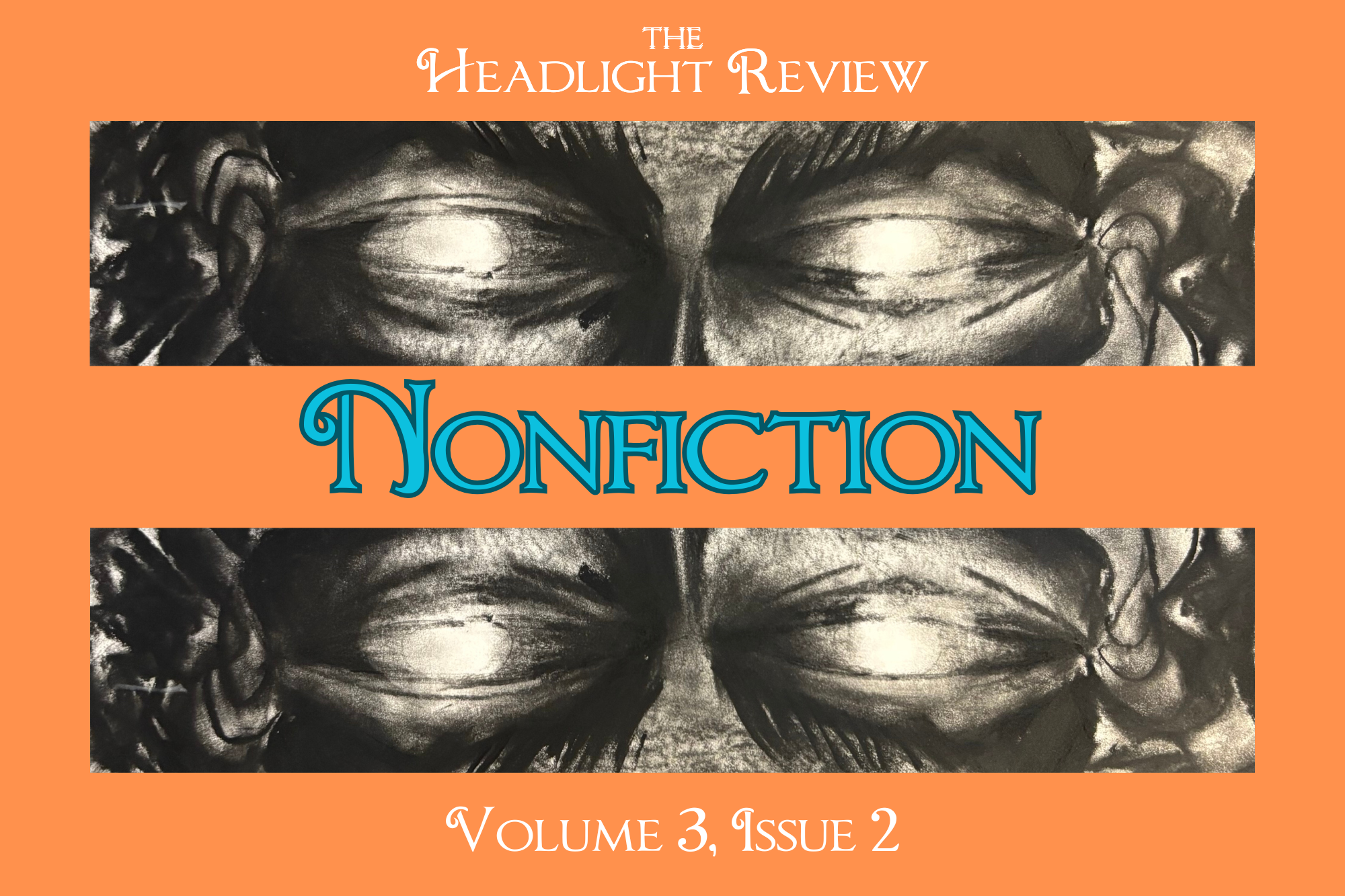
This piece was featured in Volume 3, Issue 2. Click here to explore other pieces from this issue.

Letter from the Managing Editor
As I approach the culmination of my degree, I have gone through various iterations of a capstone idea. Perhaps a collection of short stories, a novel, a novel written through short stories.
As I approach the culmination of my degree, I have gone through various iterations of a capstone idea. Perhaps a collection of short stories, a novel, a novel written through short stories. How many perspectives should I include? Would one be too limiting? Would six be egregious? And, of course, at the crux of it all, the age-old question: what is the story that wants to be told?
Needless to say, it’s been an ordeal trying to figure out the answers, and it would be an understatement to say I have been nervous about all of this. I wanted to start early, get a head start on what I’m aiming for in the fall so I don’t stumble too often. This summer, however, I’ve pivoted much of my energy from capstone prep to my work at The Headlight Review. It’s had me contemplating a great deal about what the submissions we’ve accepted do to grip me, what I can learn from them as I gear up for spelunking the depths of my creativity.
My favorite part of my working on this issue has not simply been copyediting, reformatting, or proofing, but the engagement I have had with the authors, poets, and artists. Corresponding with the person behind the work is my favorite part of any role in editing. If you know the creator, you get to know the piece better, understand the nuance of what they want to say and how they want to say it.
And there I found it. The core of what I need to do to understand my capstone better. And it’s the same invitation that countless literary magazines send to potential contributors: Share a composition that is uniquely yours, that only you could ever create.
Will oil or gouache better convey the way your eyes funnel sunlight? How many characters are needed to express the complexity of your grief? Does the line need to break at a different point to give the impact you desire? The varied and unique answers to these questions are what set each of these pieces apart from the rest.
Captured within this issue of The Headlight Review are three fictional stories, five nonfiction pieces, the visual art of four artists, and the work of a whopping twenty poets, which includes our Chapbook Prize winner and finalists. Each contributor to this issue has a distinct narrative to share, one that only they could ever do justice by sharing it in their own unique voice. It is my greatest hope that you, reader, will absorb each of these pieces with compassion and care, knowing that they, in all their complexity and nuance, came from real people.
To our contributors, I’d like to extend my gratitude for making this experience so enjoyable. To Brittany Files, thank you so much for your guidance toward my start in this role. To the whole THR team, thank you for the warmth with which you’ve welcomed me onto the masthead.
And to our readers, I hope this issue inspires you to walk your stories past the page, your poems through time and space, your art over the edge of the canvas. To share your stories with the world and let them find themselves at home somewhere beyond your mind.
This piece was featured in Volume 3, Issue 2. Click here to explore other pieces from this issue.

Two Paintings

Colors of Heritage, digital painting
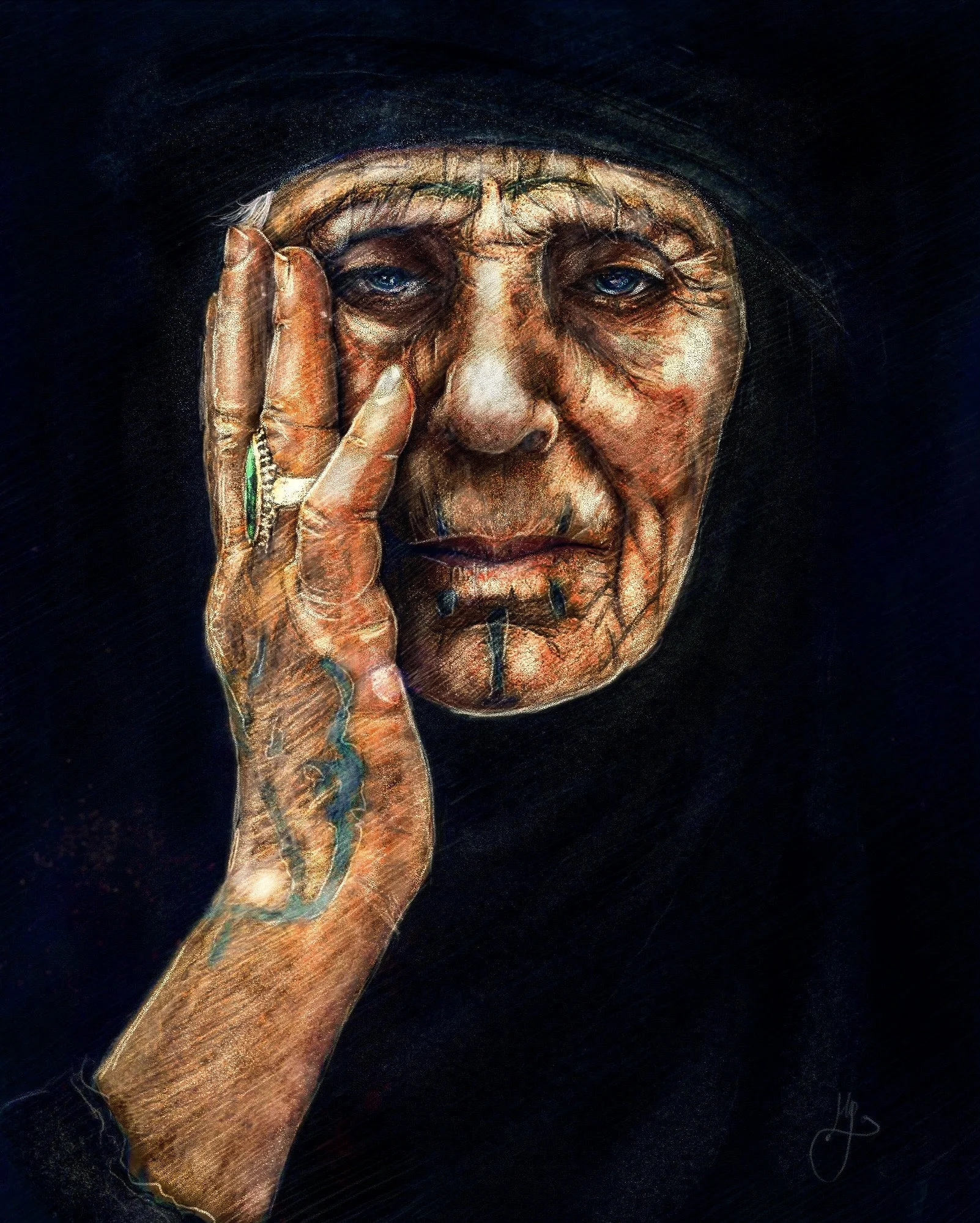
Wisdom in Her Eyes, digital painting
This piece was featured in Volume 3, Issue 2. Click here to explore other pieces from this issue.
Artist’s Statement
Gorjian’s work focuses on digital painting, GIS, and urban design, reflecting themes of tradition, identity, and resilience. Through her art, Gorjian aims to bridge past and present, using digital tools to document and celebrate cultural heritage. She has exhibited her work nationally and internationally, engaging audiences in conversations about history, storytelling, and the evolving role of digital media in preserving tradition.
Still Standing
After over fifty years, Warren and I began corresponding—a term I use loosely, as Warren does not write. He does not speak. His IQ hovers below 20, and he does not know who I am.
After over fifty years, Warren and I began corresponding—a term I use loosely, as Warren does not write. He does not speak. His IQ hovers below 20, and he does not know who I am. This is an excuse I saw my parents embrace most of their lives to alleviate the guilt of no contact, of giving up their parenthood, when it came to their fourth child and firstborn son.
Warren was about two years old when it became increasingly evident that something was wrong. He would spend hours sitting on the floor, with his head against the wall, rocking back and forth as if keeping time with the ticking of a metronome only he could hear. His hair had worn a little bald patch in the spot where it met the plaster. Words were not spoken; words were echoed, much like a parrot mimicking what it heard. No words came out of their own accord. No babbling two-year-old banter, the type we parents sometimes complain about. I’m sure there was no complaining by my parents. Only worry. Enough worry to make appointment after appointment with specialist after specialist. Diagnosis: Severe Mental Retardation. Age three.
~
“The Benches” was the place all the mothers of the building would meet with their toddlers and strollers to socialize and gossip. It was a long strip of a park adjacent to Henry Hudson Parkway with benches extending a city block. I remember playing there as a child with dozens of other kids from the building. I have very few memories of my childhood, but “The Benches” I always remember as a safe place. I have had recurring dreams in my adult life of various scenarios where someone is chasing me, trying to kill me, etc. I always knew that if I could just get back to “The Benches” and lay down on the concrete, I would always wake up in my bed. I would be safe.
Mom was embarrassed to have the other moms see her son, who was not quite the average child. So, instead of her usual routine with the older children, of going to The Benches with the other mothers, she would take Warren in the stroller and walk for hours, she told me, so her baby would not be seen, and apparently, she would not be embarrassed. It was the 1950s, but it is still hard for me to fathom.
The doctors, the specialists, and even the Catholic priests would all weigh in. It was decided that the best thing for all would be to place Warren in a home for the mentally ill. The decision was made that Warren, not yet four years old, would be sent to one of the best private institutions in the Greater New York area. I remember driving north, up the tree-lined Saw Mill River Parkway every Sunday afternoon to visit Warren. I was eight.
We would go to the Carvel ice cream stand down the road. Sad but true, this is the only concrete memory I have of my brother. Carvel on Sundays.
To be fair to my parents, it is what you did in the 1950s. Your pediatrician suggested it, and all the specialists recommended it. Many families faced these same choices. For some, it was a deep, dark family secret, not even knowing that their sibling or relative even existed. For others, there would be weekly visits. I know it was not easy for any of them.
My father was manic-depressive in the days before lithium. With three children of my own (all born within twenty-seven months of each other), I have often wondered, what would I have done? There are those who say that the parents were ashamed. Others say they just threw their children away and forgot about them. I do not pretend to know the answer. Unfortunately, what goes up must come down. The mania of my father, along with his record-breaking sales performance, came crashing down. When my father was in a manic stage, he could sell ice to the Eskimos. He was hospitalized, and the income dried up. The private institution had to give way to a state mental hospital, maybe the three most dreaded words in the English language.
Warren was transferred to Willowbrook State Hospital on Staten Island. It was actually called a school, and it was the largest institution for the developmentally disabled in the world at the time (and that was not a good thing).
~
My brother spent about fifteen years of his life at Willowbrook, the place that Robert F. Kennedy called “a snake pit” in 1965. When Kennedy visited the site, he was horrified by what he saw and stated that “individuals in the overcrowded facility were living in filth and dirt, their clothing in rags, in rooms less comfortable and cheerful than the cages in which we put animals in a zoo.”
A combination of budget cuts by Governor Nelson Rockefeller and more demand for placements coupled with indifference led to most of Willowbrook’s problems. Some quote a ratio of seventy patients to two or three caregivers. I wonder how those caregivers could keep clothes on the backs of children with mental disabilities as severe as most residents, who would disrobe as fast as staff could dress them. How could they keep the feces and urine cleaned up when there were seventy other children to look after?
I visited Willowbrook once. It may have been more than once, but the first visit is all I can remember. It was the Fall of 1970. I was twenty years old. I had been visiting my brother from the time I was eight years old. My two sisters, ages 4 and 9, and I, would pack into my parent’s car and drive the half hour or so up the tree-lined highway to Ferncliff Manor in Yonkers. It was a beautiful place with acres of grass. We would lay a blanket out and have a picnic with our brother. We would run around and play, especially my younger sister, as they were the closest, only about a year and a half apart in age. She missed her baby brother.
Willowbrook, on the other hand, was far from the pretty, peaceful picnic grounds of Ferncliff. The antithesis. When I first entered Willowbrook in 1970, I was with my father. My mother would not or could not return. My senses were bombarded. The scent was sharp. A mixture of bleach and feces. The air was still. The halls were dimly lit so as not to see the chaos or the peeling paint. The sounds I could not quite place: murmurs, distant cries, quiet humming, the shuffle of feet. There was a sense of stillness that felt anything but peaceful. I had not prepared myself for what I saw that day, but even then, I had the sense this place was failing the very people it was meant to be helping. A kind of numbness settled in—not because I didn’t feel it, but because I felt too much and didn’t know where to put it.

Dunham as a child with her mother and siblings, photographed by Burton H. Halper
It wasn’t chaos. It was something softer and harder to bear—indifference. Neglect masked by the very rhythms of daily life.
That day left a lasting mark. It didn’t just shape my view of institutions—it asked me who we become when we are unseen. Does Warren know he has a family? A majority of the residents there have no visitors at all. Unfortunately, I did not pursue those questions or those feelings I had that day, for many years. I buried them with all the rest.
It breaks my heart when I look at this photo taken when Warren was just a few weeks old because I see such hope. Children with such great prospects, immense potential. A future not yet marred by illness and tragedy. We were all unaware of what lay ahead.
It saddens me now because I know the outcome. I lived through it. The memories feel like a slow echo that never quite fades. There would be two more children to come, and the youngest would, in essence, never have the opportunity to know two of her siblings pictured here. In fact, she was not even told of their existence for years.
Lorraine, my older sister on the right would become affected by schizophrenia in her teenage years and commit suicide in 1967. Warren, the newborn in momma’s lap, would be institutionalized by the age of three, and dad, the photographer, unbeknownst to me at the time, would suffer from Manic Depression/Bi-Polar I for the rest of his life. I was sixteen years old when lithium became FDA approved for his type of mental illness. I didn’t fully recognize my family situation for many years. Like all small children, I perceived my life as typical. Of course, it was the only family life I had known. I used to think I had a perfectly normal childhood growing up in an upper-middle-class family in a particularly good neighborhood of the Northwest Bronx. Still, all is not always as it seems.
So, it has been fifty years since that day at Willowbrook. Fifty years of distance is not just a timeline; it’s a slow layering of choices, silences, rationalizations, and even regret. I had always blamed or perhaps rationalized my parents’ behavior for not visiting and for moving 2500 miles away. But what about myself? Was it guilt for not challenging the patterns my parents set? Was the guilt shaped by family dynamics and motional survival?
When you believe someone doesn’t recognize you, especially someone you’re biologically and emotionally tied to, it can feel like the connection was broken before it even had a chance to be made. “What’s the point? He wouldn’t understand. He wouldn’t know me.” But underneath that logic is a powerful current of loss—not just of a relationship, but of significance, visibility, and possibly identity.
Saying “He didn’t know who I was” may have been a way to protect us all from pain. There’s grief for what never existed: no history, shared memories or stories passed between siblings. And that grief is quiet. It just lives silently under decades of rationalization.
~
Since 1985, at the age of thirty, my brother has been living in a group home in upstate New York. The Consumer Advisory Board (CAB) monitors his wellbeing, which provides necessary and appropriate representation and advocacy services on an individual basis for all Willowbrook Class members as long as they live.
Warren has been well taken care of for the past thirty-eight years of his life. He has his own advocate who makes sure that all the stipulations of the Willowbrook Decree of 1975 are being followed when it comes to someone from the Willowbrook Class, as is my brother. But I often wonder, what about the trauma of the past? What does he comprehend of the horrors of growing up in an institution such as Willowbrook?
I am in contact with his advocate as well as his local case worker. They say he seems happy but does tend to withdraw and isolate himself. He doesn’t trust people very much. I suppose I can’t blame him. He is electively mute. Not to mention that Warren is missing the tops of at least six fingers, and, sometime in the past, his nose has been broken. Warren also has no teeth. I read an account of a Willowbrook parent stating that the Willowbrook dentist was notorious for pulling teeth. Her child had no teeth because she would bite herself until she bled. Whether this is connected to Warren’s missing fingers or missing teeth or is a result of abuse or self-mutilation remains a mystery.
~
Warren loves classic rock—a man after my own heart. Music therapy is essential in the lives of the mentally disabled, probably because music is nonverbal. It transcends language. My brother is nonverbal, and I like to think that the music he listens to speaks to him in some way. I know that music calms anxieties and relaxes us when we are overstimulated. I’m told he can spend hours sitting in a rocking chair on the back porch of his group home in Plattsburgh listening to his CDs: He likes everything to be in its correct place, such as furniture being arranged in a particular way, or the house phone hung up in a certain direction. They say he can be quite helpful in clearing things away, such as mats after PT, arranging and clearing the living room after various activities. Sometimes, amusingly enough, his arranging can happen while the activities are still in progress! This brings a smile to my face!
Warren has a personal savings account that cannot accumulate over $2,000. When the account gets up there, they go shopping to spend it down. His basic needs are taken care of, so he can shop for things he especially likes. His caregiver said Warren has the most expensive taste of any man she’s ever met. They will go to JCPenney, and he will go directly to the silk shirts or the most expensive items they sell. He is a very “interesting and complex” person, she says. It shows the respect that he garners as an individual, not simply someone or something to be taken care of. Not forgotten.
~
It had been fifty years since I saw my brother, The last time was that visit to Willowbrook in 1970. Not long after, I left New York for the west coast at about the same time my parents left New York. While my mother was alive, she would get annual reports on his health and progress and always shared them with me.
My youngest sister, Stacey, had never met Warren. He was institutionalized eight years before she was even born. She can’t quite remember when she was told that she had another brother. It was probably when she was about seven or eight years old.
When I brought up my plan, she was hesitant at first, but we finalized our trip and met in Montreal for a three-day visit before driving to Plattsburgh, New York, together in October 2023 to meet our brother. We had also arranged to meet both Warren’s care manager and his advocate from the New York State Office for People with Developmental Disabilities (OPWDD) for lunch in a nearby café.
I was heartened to learn of the care that the State of New York is giving to those with developmental disabilities and the extra care for the “Willowbrook Class.” Meeting these two women in that café was proof enough of the care and concern that my brother is getting. They spent two hours with my sister and me talking about Warren, listening to us recount our own family history, and answering any questions that they were able. They could not have been more caring and sincere. I am so grateful to have met them. Not only did they spend those two hours talking with us, but they also went with us to meet Warren. He was familiar with both, so they carved out even more of their busy days to come along.
We arrived at the house on Turner Road. It was out in the country among the trees. The feeling was peaceful and bucolic. His house manager greeted us and let us know that the other housemates had gone out so that we would have more privacy and less chaos.
There are four male house members. I believe at age sixty-eight, Warren is the oldest. Two of the men are more high functioning and a bit outspoken, while Warren is selectively mute and very low functioning. The fourth member falls somewhere in between, and it all works.
The house manager told us that Warren had just gone to his room to lie down. His advocate went and peeked her head in his room to say, “Warren, you have some company. Do you want to come out and say hello?” No response. His habit is to get into his bed with his legs crossed in a yoga position, then pull the blanket over his head and lie down. He looked like a not so little cocoon. I then said, “Hello Warren, I brought you a present,” and he immediately popped up from his bed and ran down the hall to the dining room table. He moves very quickly (and apparently even quicker when there is a present involved).
A bit later, we went out to his favorite spot on the porch where he sits in his lounge chair to rock and listen to music. We went through his box of vinyl albums sitting next to the record player. I was a bit surprised. I had to laugh and think, He’s a man after my own heart. There was Pink Floyd, Led Zeppelin, Fleetwood Mac, The Beatles (his favorite) and even AC/DC and Metallica!
So, Warren came out of his room to get his present. I brought him a Seattle Sweatshirt, as I know he loves sweatshirts. He went straight to the kitchen to get strawberry milk. The house manager poured his milk and then let him pour in the strawberry syrup and mix it up. They brought it to the table where he gulped it down as fast as he could and some of it spilled down the front of his shirt. All those years at Willowbrook ingrained in him that everyone would steal his food if they could, so eating or drinking as fast as he could was the only way to protect it. To this day, he must have someone watch him eat so the food doesn’t go down too fast and choke him. When a new member of the household is added, Warren will either bring his food to his room or else put his arm around the plate, protecting it from the would-be food thief. Once he is comfortable with the new house member, he will come back to the table for meals. It has been thirty-eight years since Warren left Willowbrook. Habits die hard. I only wish I knew what other horrible memories reside in his brain from spending his most formative years there.
He came to the dining room table and sat across from me.
We looked at each other. There was a connection of some sort. I asked if it was alright to take a picture. His advocate asked Warren if it would be ok, and he immediately jumped up from the table. I thought, oh no, he’s going to run back to his room, and turn back into a cocoon. To my surprise, however, he stood up, went to the middle of the room, and looked right at me, as if to say, “I’m ready for my picture now.” I thought I would quickly take advantage of the situation and handed my phone to Stacey and asked her to take a picture of both of us. I nonchalantly went over and stood next to Warren.
At one point Warren grabbed my arm and started pulling me towards the kitchen. I thought this was a real moment between us, but it turned out, he wanted more strawberry milk. When I realized, I just laughed and said, “Oh, he’s just using me.”
We had a total of twenty minutes or so until Warren decided to go back to his room, get in his bed, and pull the blanket back over his head. Stacey, for the most part, stayed in the background. But I know she was as moved as I was by the whole experience.
He reached out and touched my hand once. I really believe we did have a connection, my brother and I. I now have a new and wonderful memory that is gradually replacing the dark one that haunted me for fifty years.
This piece was featured in Volume 3, Issue 2. Click here to explore other pieces from this issue.

Excerpt from Salt Bones
An excerpt from Salt Bones by Jennifer Givhan (Mulholland/Little Brown, July 2025)

Cover of Salt Bones by Jennifer Givhan
The Salton Sea,
Southern California
An excerpt from Salt Bones by Jennifer Givhan
(Mulholland/Little Brown, July 2025)
___________________________________________________________________________
Thick, noxious air burns her throat as she flees through the fields, mud clotting to her soles like leeches, one untied shoe after the other over the rutted vegetables.
She shouldn’t run toward the water—it isn’t safe. But the murk would offer cover.
She doesn’t risk a glance behind her or fumble at the yellow onions bulging from the ground. At first, it’s the familiar stench of sulfur bubbling from deep in the earth, mangled with the smell of rotting fish, thousands of carcasses gurgled onto the brackish marsh just ahead.
Then something intoxicatingly sweet fills her nostrils. She’s not near the sugar plant on the other side of town, but those sugar beets smell like overripe dirt anyway. This is more walking into the donut shop at sunrise and ordering a maple bar and sweet tea. She shakes her head, sure her blood sugar’s collapsing from starvation and dehydration and she’s about to nose- dive into the fields when the sweetness sours just as suddenly as it came—and she’s overtaken by the dank stench of sweat and shit.
Her heartbeat throbs in her ears, eclipsing the sound of a truck engine’s roar—another predator in the night, tearing through the furrows and ruining the crops, chasing her.
Would anyone hear her if she screamed?
She can’t waste the breath she needs for running.
In the distance, golden lights twinkle a mythical city arisen in the nowhere between the closest towns, neglected or desolate, and the still-living, breathing town where her people are.
But the lights aren’t magical, and they’re far, much too far. She’d never outrun the truck to get to the geothermal plant where someone at the gate might hear her. Let her in. But would they believe her if she told them who was after her?
A few hundred feet ahead stands a dock. Rickety and slanted, but still possible cover. She could jump into the frothy, stinking water, hold her breath, and hide beneath the battered, salt- crusted planks. Her pursuers might assume she’s darted toward the wildlife preserve, climbed the chain link. Or drowned.
The fug of gasoline and exhaust commingles with the acrid sea, fertilizer, her own sweat and spit, and her blood pumping, pumping furiously. Her lungs scream. Don’t let me die out here—
The sky lights a purple path upward—the Milky Way beckoning as if someone’s holding a flashlight behind a pinpricked cosmic bedsheet. It cascades across the expansive blackness that blurs into the jagged peaks of the Chocolate Mountains beyond this stretch of desert that’s claimed countless lives.
The clomping of hooves and a blaze of headlights pierce her back. Her dark hair flaps crow’s wings against her sweat-drenched hoodie as her high-tops slip against the mud.
There’s nowhere to hide, no tree cover, nothing but shrubs and dirt, and the green fingers of onion bulbs wavering the hands of the dead, reaching for her, grabbing, pulling her downward.
She falls to her knees, blackening her hands with soil.
But the creature canters steadily toward her.
She scrambles up, the Salton Sea in sight, a soupy bog in the darkness.
Her feet crunch fish bones and the minuscule shells of dead crustaceans; millions of them crackle beneath her while she flies toward the pier stretching into the abandoned lake, all that “accidental” water sloshing for miles across the dusty bowl of valle, before the headlights overtake her, and the horse-headed woman cackles, her midnight-black mane scraggling down her bare back.
For a moment, she’s glowing yellow, gleaming with beads of sweat. Saintly.

Jennifer Givhan, author of Salt Bones
Then the gunshots resound.
One. Two. The deafening booms reverberate through the mountains. Aerial drills. Only this is no drill. Following the shots—metal clanks its sick click, click. Boom, click, click. Boom.
If anyone were out here but the night animals, the stars, they’ve shut their eyes.
_______________________________________________________________________________________
Jennifer Givhan is an award-winning Mexican American and Indigenous poet and novelist from the Southwestern desert. To learn more about her upcoming fourth novel, Salt Bones, from which this excerpt is taken, read our interview with Givhan in conversation with Mary McMyne in the “High-Beams.”

Three Drawings
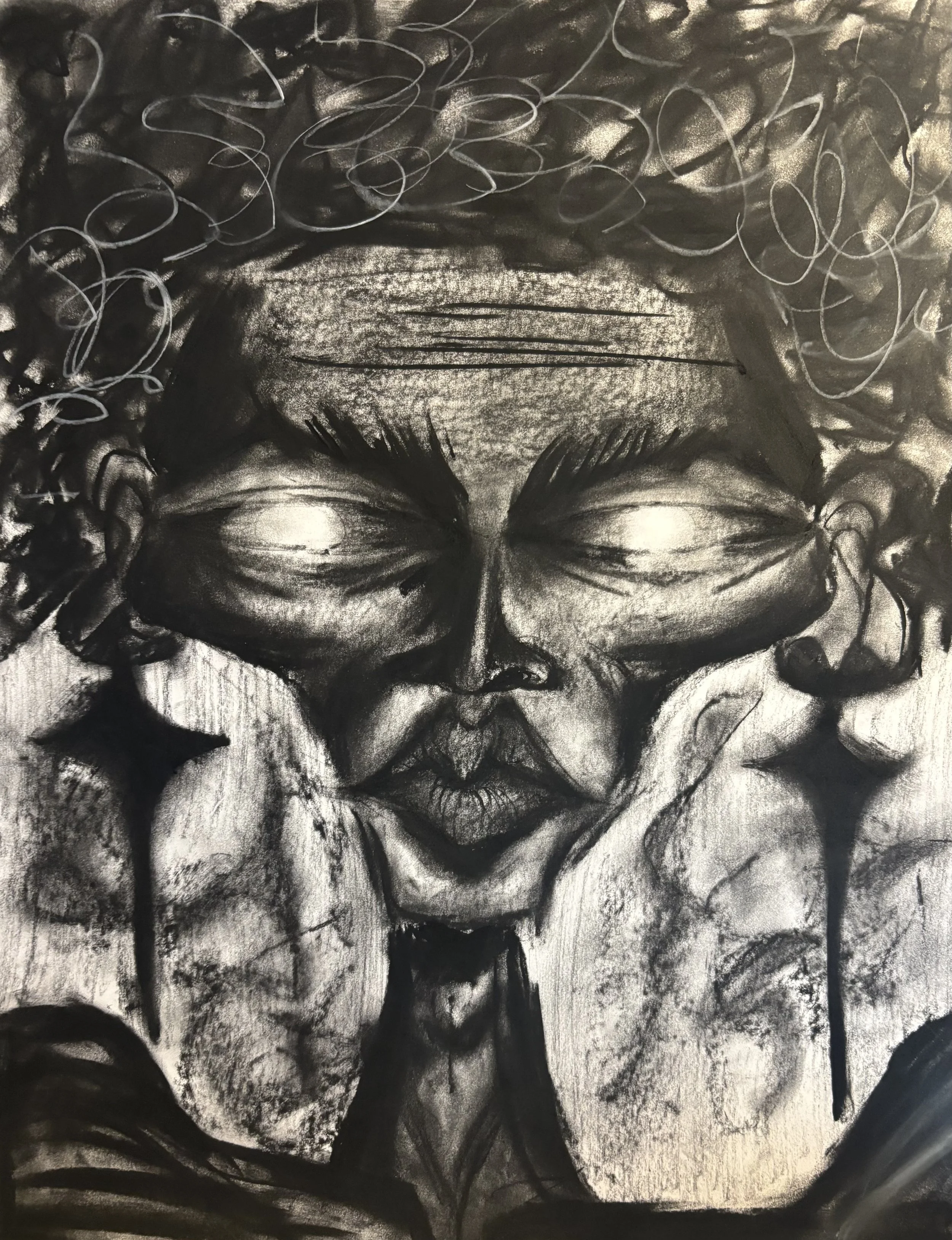
Charcoal Drawing 1400

Color Drawing 1400

Color Drawing 3400
This piece was featured in Volume 3, Issue 2. Click here to explore other pieces from this issue.
Artist’s Statement
I believe art is beautiful because it is liberated from any ties to ‘practical’ usefulness or productivity and instead exists only to provide radiance to life. Visual art is an escape from the utilitarian movements people become so accustomed to. I want to visually express what queerness is, find the ideal form, the spirit of queer people, and present it in a way which others can understand the elegance and taste of.

Two Poems
see, the beech tree / never asked to be made palette / for the
lovebirds / armed with blades / gashing their runes / into the bark / scarring trunk / initials standing out / standing tall / for love
it is a burden to know;
it is a given to fear
teeth upon bone. blood upon snow.
skin upon skin. worry upon face.
face upon sheets. repeat then repeat.
bandage the wounds but return to the teeth.
return for more. the wound is not
a badge of the love you once received,
but it feels close enough to warrant
another tear of your flesh, another seep
of your fluids. the wound is not
a badge of the love you once received,
but it is all that awakens your
senses. the days are many but
the moments of awareness are few.
in the morning drops of dew, count
the moments you feared would pass
you by. they already have—maybe.
it is a burden to know. it is a given
to fear. when december comes knocking
at the window, knuckles chapped
in the biting wind, what answers will you have,
what lessons left to share?
someone once told me to understand
love as disease / love as invitation / see, the beech tree / never asked to be made palette / for the lovebirds / armed with blades / gashing their runes / into the bark / scarring trunk / initials standing out / standing tall / for love / beneath curls of incense with unfurled wings / the lovers pronounced / three words each / over the peeling wound / as the tree wept / and the human eyes / remained dry / engrossed in their ritual / establishment / of a lover’s pact / meant to last forever / neither human / able to admit / that forever / doesn’t have to mean eternity / only outlast / those who made the promise / or even shorter—the will to keep it / and i guess in a way / your will could be / what your forever means / but i’m not convinced eternity encompasses / such a small patch of grass / fingers in the soil / homegrown roots / my knuckles are white with grip / nightmares come / to life / i’ve seen them / sketched in crimson / what i can only assume / to be blood / running / beneath spilled milk moonlight / in the hallway that takes / hours to cross / the clocks on its walls / always ahead of me / and my watch / i feel like i’m living / life playing catch-up / three steps behind / and always faltering / always running to get back / to the carving of the beech trees / back to the lovebirds / violence disguised as love / the problem with humans / our tendency for violence / excusable by passion / masked by irrationality / the fragility of human emotion / they say lovebirds have poor sight / poor focus / flighty birds really / their passion is their weakness / and here you know / weakness is just a synonym / just a precursor to downfall / another obstacle to getting / back to those beech trees / the only things that truly matter / unfold beneath shuddering leaves / between scarred trunks / and why do you keep walking past them / as if their suffering is not vocal / earth-shattering / the catastrophic crash / of lost limb after limb / see lovebirds slice / their legacies into the skin of the tree / penetrating that protective layer / the barrier tenderly tended / since the seed casing ruptured / and the sun first graced / the virgin bark / as it stepped into the light / shaking / feverish / starving for worlds / of wind and soil / thirsty / for the elements whirling and crashing / all around / that gaping bark left behind by the / lovers enraptured / each by the other / peeling bark that festers / unlike human skin / the tree is unable to stitch / itself back together / over the wound / and hide / the spillage / the white screaming scar remains / a talisman / a legacy / an invitation to insects / to disease / infestation / and again / redefinition / leads to love as decay / love as downfall / thinning forests / and feathered arms / looped together / bringing about destruction / this hunt / this quest / this path leading nowhere / but deeper and deeper / into the forest / towards the origin of trees / and bees / i just wanted to define love / but i guess i’ll keep walking / keep looking for tracks / trying to recall the penciled path / curled over the torn map / i’ll never leave home again / i’ll never step foot here again / just tell me what it looks like / how it feels / how to recognize love / even bloodied / and heavy with gore / stumbling through the door left unlocked / some nights even ajar / since footsteps echoed down the steps / when love last left / and my maps stopped leading to you.

This piece was featured in Volume 3, Issue 1. Click here to explore other pieces from this issue.

The Wounded Stork
The dead bird on the front-door step was a barn swallow. Makhosi recognized the copper face and glossy blue hood that continued towards a forked tail. Its clawed feet were tucked together, as if it had been arranged there.
This story won the 2024 Anthony Grooms Short Fiction Prize.
The dead bird on the front-door step was a barn swallow. Makhosi recognized the copper face and glossy blue hood that continued towards a forked tail. Its clawed feet were tucked together, as if it had been arranged there.
It was early and the morning rush had not yet begun, but already the air was unseasonably warm. London, Hotter Than Athens, the newspaper declared. Makhosi glanced up and down the street, as if the mystery of the bird’s appearance could be solved somewhere along their Victorian terrace. The city was hazy with heat. Plane trees lined the pavement, their new leaves, vivid and green, arching against the bleached sky. A black cab idled outside number sixteen and distant traffic rolled like an unseen ocean, punctuated by a muffled yap-yap-yap from behind their neighbor’s door.
“Did the paper come?” Simon nudged alongside her in the doorway. He had tucked his tie away between the top buttons of his collared shirt and carried Jabu in the crook of an elbow. With his dark skin and blonde curls, their son was the perfect, beautiful combination of his South African mother and British father.
“There’s a dead swallow,” Makhosi said and crouched over the bird. Its open eye was as flat and black as a papaya pip.
“Don’t touch,” Simon said and shifted Jabu around his hip, putting his body between the dead bird and the boy. “Lice."
Makhosi tucked her hands into her lap. She’d felt the unexpected softness of a dead bird before. Some time during a barefoot school holiday on her grandmother’s farm in Zululand. Light bones beneath the feathers.
“Probably flew into the window.” Simon tilted his head towards the transom window above their front door where the numbers one and three were sandblasted in the center.
When they’d first viewed the house and Makhosi had expressed reluctance at living at an unlucky number, Simon had dismissed her superstition as “an old wives’ tale.” She knew it was considered good fortune for a barn swallow to nest in your house, but thought better than to wonder out loud what a dead one might portend. She looked up, trying to imagine the trajectory of the small body’s sudden, unconscious drop.
“But it’s perfect, as if it’s been positioned. What if someone rang its neck and left it here?”
“Who on earth would do a thing like that, Max?” There was an edge to his voice.
Dread prickled the back of her neck as Makhosi’s eyes travelled down the row of quiet windows overlooking their street. “I don’t know.”
Simon snapped a stick off the wisteria that draped above the front door and poked the swallow. The jab rolled the bird onto its back. Its neck came to rest at an unnatural angle, exposing the soft triangle of its chin.
“Broken,” he said, as if settling an argument, and handed Jabu to Makhosi. “I’ll get a bag.” He carried the newspaper down the hallway.
Barefoot, Makhosi took the boy up the path to the front gate. As a child, she would watch the high migratory V’s of birds arriving in South Africa each spring, and wonder about the vast northern world they’d traveled from. She’d imagine silent fields of snow running to the horizon like the yellow veld that flowed in all directions across the hills around her grandmother’s farm. Now, from her home in the London suburbs, Makhosi watched the swallows’ seasonal arrival and wondered if they felt regret at leaving the wide blue breath of Africa’s horizons.
This swallow would have flown thousands of miles across the Sahara, via Morocco into eastern Spain, and across the Pyrenees to summer in England. Makhosi glanced back at the bird. The air-bound creature lay incongruous against the earth. It didn’t seem right to simply dispose of the body. It deserved a proper burial. Somewhere in the small garden at the back of their house. Her oasis. Her mother, used to the more expansive suburbs of Johannesburg, referred to London backyards as “postage stamps,” and theirs was no exception, which was precisely why Makhosi loved it. It was neat and manageable, and every plant was there because of a decision she’d made, action she’d taken, and work she’d done. The accident of the swallow’s death and decay should be worth something to the life of a plant, or the soil.
Resolved, Makhosi turned back up the path just as Simon returned with a hand brush and a plastic shopping bag. He bent over the swallow and with a single, surgical movement, swept the bird into the bag and knotted the handles, once, then twice.
The unwelcome image of the bright body decaying to a slow liquid stench inside a sweaty plastic bag flared in her mind. “I was going to bury it!” She was embarrassed by the sudden emotion.
“Now you won’t have to.” Simon moved towards the bins. The bins that would bake in the heat for three days until the garbage men came. He lifted the lid and tossed the lightly weighted bag inside. It landed with a hollow thunk as another swallow darted out from the eaves of their house.
~
Jabu sat on the kitchen floor constructing a cityscape of mismatched Tupperware tubs and lids and cups.
“Swallows migrate to South Africa,” Makhosi said as she tore a banana loose.
Simon pumped soap into his palms and scrubbed his hands. “Sounds like wishful thinking.”
She peeled the banana and pushed a fork through the flesh. “Let’s move.”
“I thought you loved this house.” Simon dried his hands on a dishtowel.
“I love it because you love it.” Makhosi added a spoonful of vanilla yoghurt to the mashed banana and blended the two together. “It’s not the house, it’s more…” she waved the fork in expanding circles, trying to encapsulate the street, the neighborhood, the town, the whole country, “… I don’t know.” She thought of the watchful windows and the dead swallow. A nut of dread rooted in her chest.
“It takes time, Maxie.”
“It’s not a question of time.”
“What is it then?”
“I feel different. I sound different. I am different.” Makhosi and her words ran out of steam. They’d had this conversation before. “It’s hard for me to explain to someone like you.”
“Someone like me?” Simon said under his breath. Then, more loudly, “If you can’t explain, how can I fix it?”
“I don’t expect you to fix anything.”
Makhosi opened the cutlery drawer and piano’ed her fingers across the selection of teaspoons within. Someone like me. She wore her skin, Simon lived in his. But she hadn’t meant to highlight their differences, she only wanted him to recognize how at home he was in the place where she felt lonely. She was a new mother, with a relatively new partner in a new country. She watched other mothers meet for coffee on the local high street, their babies like happy extensions of themselves. They made it look easy. Out of the noise of metal spoons, Makhosi selected the blue plastic spoon Jabu favored. She lifted him onto the kitchen counter, positioned herself in front of him, and offered him scoops of banana and yogurt.
Simon’s phone buzzed.
“I’d better go.” He pulled Makhosi into his chest and pressed his lips against her temple, then stooped to straighten his tie in the reflection of the oven door. “I wish you’d put him in his chair.” He nudged the feeding chair towards Makhosi with his foot.
“He doesn’t like being strapped in.”
“It’s not safe.” Simon’s phone buzzed again, and his thumbs replied.
“We prefer it this way, nê, Jabu?” Makhosi blew a raspberry on the sole of Jabu’s foot. He squealed and grabbed for the spoon.
“If he’s in the chair he can learn to feed himself.”
“Okay, Simon. You do it.” Makhosi put the bowl down and stepped away.
Released from his mother’s ballast, Jabu scooted forward to reach for the spoon.
Simon lunged across the counter. “Christ, Max!” He scooped the boy up and carried him to the feeding chair. Jabu arched his back and began to scream, slamming the spoon—slimy with banana and yoghurt—onto Simon’s tie and clean shirt.
“Fuck!”
“I told you, he doesn’t like it.”
Simon handed the squirming child to Makhosi and snatched a dish towel to mop at his clothes. He unknotted his tie and threw it in the direction of the washing machine. “I’m going to miss my train.” He thumped upstairs.
“Thula, baba, thula,” Makhosi crooned until the boy quietened. She put him on the floor and handed him the spoon.
Makhosi and Simon had met when he’d travelled to South Africa to get experience in the trauma center at Baragwanath Hospital in Johannesburg, where Makhosi worked as a junior nurse. She’d been asked to show the group of young English doctors around the hospital, which had progressed to her showing them around the nightspots of the city, and after working late one night, happily acquainting Simon and his pale, enthusiastic body, with the inside of her bedroom. He’d tugged her dress above her hips and she’d twisted his tie over his shoulder and unbuttoned his shirt until nothing was between them. He’d moved into her flat, and when his work visa expired, he’d asked her to come home to London with him.
Simon’s phone buzzed face down on the kitchen counter. Makhosi flipped it over as a text from Catherine lit up his screen.
– Ready to go? –
Catherine lived next door and was a pharmacist at the hospital where Simon worked. She was one of those girls who liked to be the prettiest in the room. Catherine flirted with men, not because she wanted them, but because she wanted to know that they wanted her.
Simon came downstairs buttoning a fresh shirt, with a clean tie draped around his neck.
Makhosi held up his phone. “Your girlfriend is waiting.”
The mention of their neighbor tuned them both in to the persistent yapping coming from behind the shared wall of their terrace.
“When did she get a dog?” Simon asked.
“Not sure, but it barked all day yesterday.”
He accepted his phone from Makhosi. “She’s applying for a new position and asked me to give her a few pointers.”
“I’m sure she’d love a few pointers from you,” Makhosi said, turning to the dishwasher.
Simon pulled her towards him from behind and slipped his hands under her t-shirt. She sucked in her stomach, conscious of how her body had softened since pregnancy.
“Don’t do that,” he breathed into her neck. “I’m sorry for being a prick.”
“Jabu is safe with me.”
“I know. Of course I know that. I’m sorry.” He ran his hands down to her hips and Makhosi moved against him.
“Not fair,” he groaned. “I really have to go.”
~
Barking followed Catherine out of her front door as Makhosi kissed Simon goodbye at the gate. She was a petite woman. Well-groomed with make-up neatly applied and her bobbed hair freshly blow-dried. Makhosi was abruptly aware of her own unbrushed hair and the baggy t-shirt she preferred to sleep in, now smeared with Jabu’s breakfast. She tugged at the hem, conscious of her loose breasts beneath the thin fabric.
“Hi, Jamie,” Catherine used the anglicized version of their son’s name which Simon said, “made things easier.”
The little boy offered Catherine his spoon. She smiled and gently pushed his hand away. “You’re such a good mom, Max.”
How would you know? Makhosi thought, but said, “Did you get a dog?”
“It’s my sister’s. I’m taking care of it while she moves.”
“It barks a lot.”
“I know. Who knew having a dog was so much work? It's like having a baby!”
Makhosi met Simon’s eye and had to look away. She juggled Jabu from one hip to the other as the little boy jammed the blue spoon into her cheek and then her mouth.
Catherine continued, “I’m trying to find someone to walk her while I’m at work,” and paused—her fingers already moving to slide her house key off the ring.
Makhosi recognized in the pause the expectation of servitude. She was familiar with the expression that accompanied it, eyebrows raised, eyes wide, and lips turned up. She knew how to wait out these encounters. She had done it often enough. With the white women at the playground who assumed she was Jabu's nanny. With the delivery guy who asked, “Is the lady of the house in?” when she answered her own front door. Or the woman in Marks & Spencer who’d asked for her assistance and then seemed annoyed when Makhosi replied, “I don’t work here,” as if Makhosi had knowingly misled her. She held Catherine’s gaze until her neighbor broke with a short cough.
“The back door has a pet hatch so she can get out into the yard, which should help,” Catherine offered an, it’s-the-best-I-can-do shrug.
“We should go,” Simon held up his phone with the time displayed.
The high-pitched bark of the abandoned dog repeated behind Catherine’s front door as she and Simon walked towards the station with their heads angled towards one another. They could easily be mistaken for a couple. Two attractive professionals headed to their important jobs. Catherine’s coat had a slight petrol sheen like the iridescence in a starling’s feathers. An invasive species that must be managed.
Simon looked back.
“Wave to Daddy.”
As soon as they were out of sight, Makhosi lifted the lid off the bin and retrieved the plastic bag with its silent contents.
~
The air inside the house was close and warm, as if the heating had been left on. Makhosi kicked the front door closed and carried Jabu and the plastic bag down the hall to the kitchen.
She and Simon had traveled from South Africa to England via Europe. They’d carried their luggage on their backs and stayed in youth hostels and pensions where they’d made love on rickety beds in thin-walled rooms, with their hands over one another’s mouths. In Rostock, a small town on the Baltic Sea, they’d visited a museum where a white stork was stuffed and displayed, with an 80-centimeter spear through its neck. The wounded stork had been discovered in Germany in the 1840s. The spear that hadn’t killed it was African. The information board had described a time when it was generally believed that birds transformed into mice, or hibernated in lakes or under the sea during winter. The Arrow Stork brought with it the valuable clue that birds migrated unimaginable distances from Europe to central Africa, where, Makhosi imagined, a young hunter had pulled back his arm and let fly his spear at an ethereal creature with an expansive wingspan; a white cutout against the blue paper sky. The stork had borne its unwelcome passenger all the way to Europe. To places the young hunter could not have conceived.
Makhosi took in the pile of laundry at the bottom of the stairs, the rubbish bin jammed with nappies, and yesterday’s newspaper strewn across the counter. Banana smeared on the floor and on the feeding chair. Simon’s ruined tie. Jabu’s toys and books and building blocks tumbling out of multiple soft containers. Tupperware piled on the floor. Dishes in the sink, waiting to be washed, only to be dirtied again. Endless, thankless chores, all underscored by the rhythmic yap, yap, yap from behind the wall, ticking above the heat like a metronome.
Sweat skimmed Makhosi’s temples, pooled beneath her breasts, and pricked her underarms. She hung the plastic bag on the handle of the french doors that opened to the garden, stripped Jabu down to his nappy and laid him in his pram. She yanked off her baggy t-shirt and leggings until she stood only in her underwear. She couldn’t catch her breath. Blood pulsed hot and urgent behind her eyes and for a moment the room tilted and swayed. She unlatched the sash window over the sink and pushed it up, hopeful the air outside would offer relief, but it only brought in the hot dry bark of Catherine’s dog-child. Landing like a hammer blow. Regular, purposeless, thudding against Makhosi’s skull.
She leaned her forehead against the tiled wall, acutely aware of those few cool, hard, square-inches, closed her eyes and imagined taking flight. Disregarding gravity to lift with an imperceptible shift of her shoulders. The brush of feather against feather. To tilt and rise higher and higher into the cool air. To soar and dive. She breathed in. The room righted itself. Makhosi pushed herself up and kicked her discarded clothes towards the washer. Jabu was babbling and drumming the plastic spoon on the side of the pram, completely absorbed in his internal world. She stood for a while, listening to his charming nonsense. The space between the sounds lengthened to the even in and out of his breath. The room expanded. The air felt light. It was quiet, not only inside, but beyond the walls too. Makhosi held her breath. The barking had stopped.
Makhosi stole a quick shower and slipped on a cotton shirt and shorts. She pushed the pram with the sleeping boy into the garden, taking the light plastic bag with her as she went through the french door. Sunshine bleached the sky. Undisturbed by any breeze, the plants and flowers seemed to twitch and shimmer in the heat. She directed the pram into a corner of shade, as deep as it could go, then adjusted the canopy against the light. Jabu slept on. A chaffinch landed on the bird feeder and snapped a sunflower seed in its beak, to peck out the soft nut inside.
The small swallow had left its nest this morning, flicked its feathers, lifted its voice to the new day. She thought of the wounded stork, of the peregrine falcons that hunted through city skyscrapers, the white storks that nested on chimney spires, and the pelicans that lived on the pond in St. James Park.
A clematis waited in a black plastic tub alongside a hole Makhosi had dug the day before. It had begun to flower and searched the air with its blind tendrils for something to grip and climb. Makhosi had dug the hole next to the fence that divided their back garden from Catherine’s, so the clematis could use the slatted wood for support. The flowers had wide, white petals, blushed with lilac tips, which cradled a tighter cluster of purple petals at its centre. A flower within a flower, would make the perfect marker for the swallow’s grave. Makhosi reached into the plastic bag and laid the dead bird on the ground between the fence and the hole, careful to restore its neck to a natural position. She rose to get the hose.
A small, white, curly-haired dog pushed out of the pet hatch and stopped in a rectangle of shade on the terra-cotta paving stones in Catherine’s bare backyard. A lock of fur had been brushed and gathered in a ribbon on top of its head, like a toy you might find in a child’s handbag. It spotted Makhosi and began to bark. The exertion lifted the animal off its feet with a short hop of determination. Bark. Hop. Bark. Hop. Bark. Hop. Not in alarm, but as if it was calling, its brown eyes fixed on hers.
Jabu began to wail.
“Hey, wena, stop that noise.” Makhosi rapped her knuckles on the fence.
The dog rushed over, its entire body shaking with the force of its tail wagging. It shoved its snout through the gap between the ground and the lowest wooden slat, and lapped and licked in excitement and nervous greeting.
“You’re noisy for such a little girl.” Makhosi squatted and reached her fingers through the fence to scratch the dog behind its ears. It pressed into the affection, nuzzling her palm. “Do you miss your mama?”
The animal did an excited dance, twisting its compact body in a tight circle before returning for more. It made a high excited whine, like air escaping a balloon. Makhosi laughed and felt herself soften towards the dog and towards Catherine. Living alone, trying to be helpful to her sister, while making her own way in her career. Maybe she should be a good neighbor and offer to look after the dog? She was here most of the day anyway, and Jabu might like it. She pictured herself pushing the stroller, with the little dog running alongside her through the cow pasture, where the summer herd of ambling bovines with their sharp, grassy smell, grazed on the banks of the Thames.
Jabu continued to cry and Makhosi crossed the small yard to comfort her child, stroking a finger in a slow rhythm between his eyes. The small dog leapt against the fence with excitement, landing both its paws along the lowest strut and barked. Jabu felt hot. Makhosi lifted him out of the pram and bent to the tap where she let cold water run over her open palm, then swiped it around the back of his neck. The little dog yapped and scratched at the fence, pushing its nose into the soil as if to dig its way to them. Jabu calmed as Makhosi walked him around the garden. She hoped to soothe him back to sleep, but he was too distracted by the dog, scratching, whining, digging under the fence.
Makhosi went across to settle the dog, just as the animal darted its small nose under the fence and grabbed the dead bird in its jaws.
For the second time that day, she rushed towards the dead swallow as it was swept away from her. “Stop!” She called for the dog to drop the bird. To release. Release! But it dug in, exposing needle teeth and pink gums behind its blue and copper-feathered prize. Makhosi smacked at the fence with her free hand, until her palm stung, “Let go!” Her skin fizzed with adrenalin and rage.
Jabu began to cry.
Still gripping her son in one arm, Makhosi dropped to her knees and pushed her other arm through the slats of fence. Ignoring the splinters she snatched at the dog’s scruff. The animal jolted its head back, drawing the bird deeper into its mouth to secure its grip. Jabu was crying with the full force of his lungs. She could smell her son’s distress. A mustiness beneath the usual baked dough scent of his skin.
With effort, Makhosi calmed her voice, “Drop the bird. Drop it.”
The dog shook the swallow in its jaws. The defenseless blue head dangled and flinched.
A rage, like a white light, blazed behind Makhosi’s eyes. She clenched her teeth and pushed her left arm further through the slats. In her right arm, Jabu screamed and braced against her body. The dog crouched. Brown eyes stared at her. Its top lip curled back.
“Here, puppy,” Makhosi sang.
The dog replied with a low growl, but took a few slow steps forward. It thought it was a game. Maintaining eye contact with the animal, Makhosi pushed through the fence up to her shoulder. She felt the hot sting of a graze along the tender skin on her inner arm.
“Here, puppy,” she flicked her fingers. “Come to mommy.”
The dog took a few more careful steps, keeping its hold on the bird. Makhosi flicked her fingers again. The dog approached and sniffed at her palm territorially. When it was close enough, Makhosi grabbed the poodle by the scruff of its neck. She expected it to struggle but instead its small body immediately relaxed with some cellular memory of a mother’s gentle jaw carrying its body to safety. She dragged it closer to the fence and secured her grip. Makhosi began to shake the animal back and forth. “Drop it. Drop it!”
Her cheek chafed against the wood. Her shoulder ached and the skin along her arm stung like a burn. Jabu had a fist in her hair and he arched against his mother’s awkward embrace. She closed her eyes and kept shaking. She shook against the empty nests, the lost birds who fly across continents only to mistake a glass window for open sky, the judgement pouring from a dozen careless mouths. Catherine in her petrol-sheen dress which hung from her slim frame, You’re such a good mother, Max. Her own mother, You should raise your child with family, so he learns who he is. The white nurse in the London hospital where Jabu had been born, standing just out of arm's reach as Makhosi struggled to get him to latch on, asking, But isn’t it normal to breastfeed in your culture? Her English mother-in-law, directing her words at a crying Jabu, Poor baby, isn’t your mummy feeding you enough? Simon, this morning, telling her their son should be more independent. Not understanding for one minute how much it hurt for her role in Jabu’s life to be so casually erased.
Makhosi shook until the bird landed on the terracotta tiles in a disarray of wet feathers and clawed feet. She let go of the dog. It backed into the shade, panting hard and watching her with its round brown eyes. Makhosi scooped up the bird and pulled her prize through the fence. She drew her son into her body. Her neighbor’s blank windows leered into her yard. She tilted her head like a crane listening for the whisper of a mouse in the reeds. No bird song and no hum of traffic disturbed the garden. No dog barked. The world was still. Makhosi began to cry.
~
Jabu was asleep upstairs when Simon’s phone buzzed on the arm of the sofa. He stood and walked to the kitchen with his eyes on his screen.
“Catherine didn’t get the job,” he called over water drumming into the kettle.
“She didn’t?” Makhosi followed him to the kitchen.
Simon twisted a knob on the stove and held it down. It clicked until a blue flame erupted beneath the kettle. “Did the dog bark today?”
“It’s just lonely.”
“Tea?” he said.
She nodded.
Simon took two mugs out of the cupboard, tossed a tea bag into each, then crossed to the sink and looked out the window at their back garden.
Makhosi joined him. It was twilight, and a golden glow lit the space like a blessing.
“You planted the clematis.” Simon lifted her hand and kissed her wrist, his breath against her palm. “We can be happy here, Max. Can’t we?”
A pressure wafted off the bridge of her nose, like feathers shaken from a wing. Makhosi leaned against her husband. He smelled of heat and aftershave, underscored by the familiar acidity of hospital disinfectant. Together they looked out at their postage-stamp yard.
The young clematis angled its stem up the fence post.
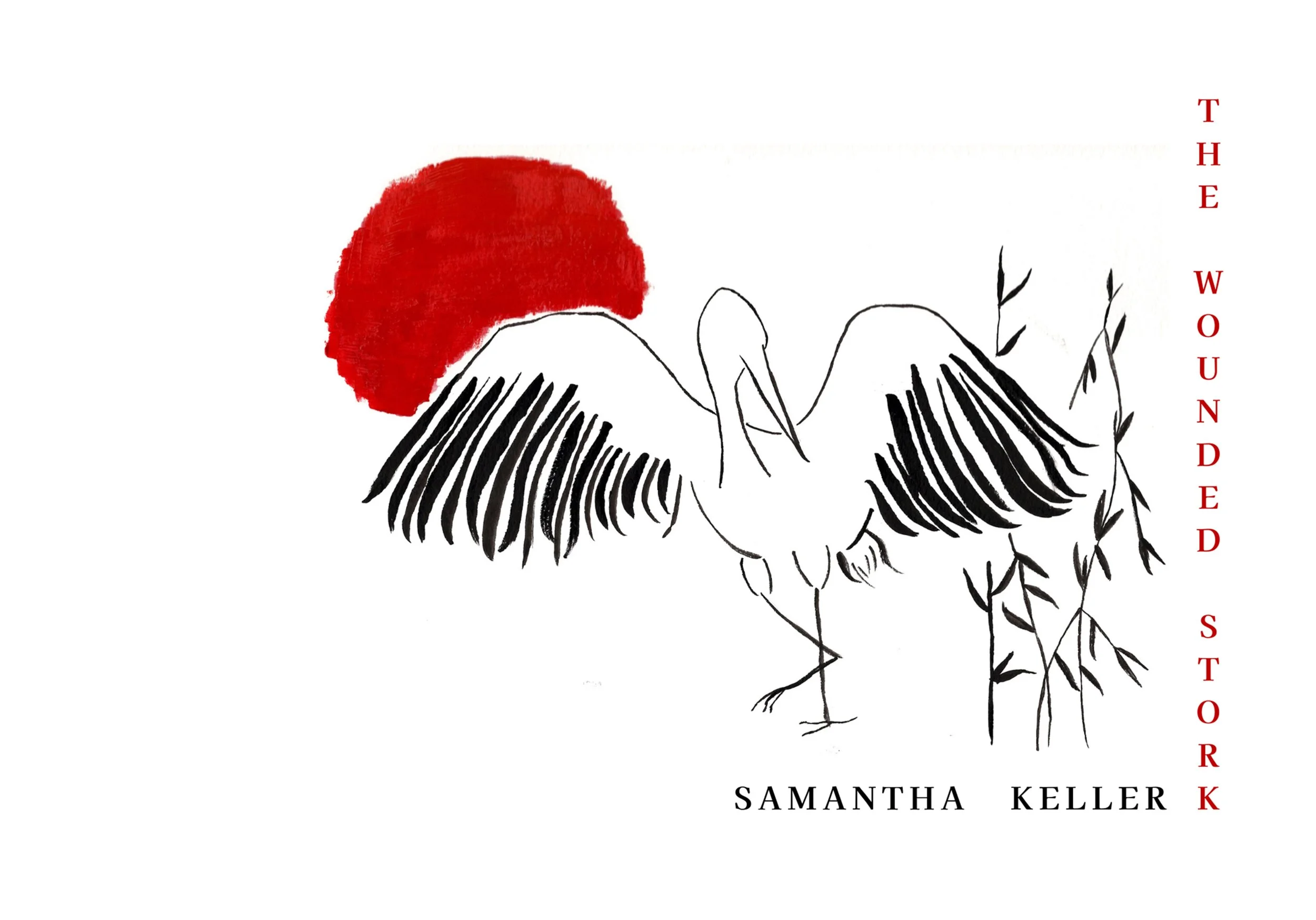
The cover of the printed version of “The Wounded Stork” designed by Brittany Files
This piece was featured in Volume 3, Issue 1. Click here to explore other pieces from this issue.

A Puerto Rican Bathroom
Last St. Patrick’s Day I was groped / on the sidewalk outside Tin Roof. / Too much Jameson was how we got there, / waiting for an Uber / that would never show.
Last St. Patrick’s Day I was groped
on the sidewalk outside Tin Roof.
Too much Jameson was how we got there,
waiting for an Uber
that would never show.
Our best day yet was at Boulder Pointe
Golf Club; I wore two sweaters
and his Patagonia like a dress over top.
Sundays are supposed to be
Mrs. Butterworth’s: warm, and
sweet, and slow.
Last Taco Tuesday a stranger told us
Jesus was gay and poly.
Tipsy on a Maiz margarita, a man
tried to track me and Gabi to our car.
Thank God they noticed; my thoughts
were wandering Maybury Sanatorium
like a drunken jungle gym.
In four days I will be my sister’s Maid
of Honor, in a dress from California, beige
three inch heels from Target.
English is my first language, but
"honor" is an elusive term.
Jeep Cherokees have been following
me everywhere, leaping
out of left turn lanes all over town.
They bring me back to August,
back to Calvin Klein skin,
back to a Puerto Rican bathroom
I will never set foot in.
This piece was featured in Volume 3, Issue 1. Click here to explore other pieces from this issue.

Re: I HAVE DECIDED ABOUT POETRY
Red graffiti says I HAVE DECIDED ABOUT POETRY & it’s like, what did they decide / exactly, that poetry’s so great they left their family moved to the mountains / lived in a little tent in the middle of nowhere writing haikus 24/7? Or did they decide / poetry’s so not worth it
Red graffiti says I HAVE DECIDED ABOUT POETRY & it’s like, what did they decide
exactly, that poetry’s so great they left their family moved to the mountains
lived in a little tent in the middle of nowhere writing haikus 24/7? Or did they decide
poetry’s so not worth it, went into business selling widgets to wankers
at 100 bucks a pop instead; floated stocks, shares shot up & crashed back down, now
they’re in the gutter wishing they were dead? Or did they decide poetry’s
what you do when you can’t do anything about babies getting their legs blown off in
Gaza (or in any of the endless wars coming soon to your doorstep), but
you still want to be Good so you make up some cute little clichés about how Bad it all is
& you win a prize named after this dead white guy, then you get to go
on living The Good Life far away from the blood & guts the dying & the crying? Or did
they decide to play games with suckers like me, looking for something deep
in red BS sprayed on walls, & now they’re sitting there laughing their ass off while they
read this trash? Or maybe they just wanted to say they’ve decided about
poetry without saying what cos it’s nobody’s business but their own; meanwhile I can’t
decide if it’s good or bad there’s not enough spray in the can to paint the town
red with my word salad, when the graffiti only needed five little words to start WWIII.
This piece was featured in Volume 3, Issue 1. Click here to explore other pieces from this issue.

Thursday
Nearly 21,000 kids are simply unaccounted for in Gaza. They lie under their homes’ stones. / In Idaho, a dry breeze drifts from the sycamore across my windowsills past the lilacs. / I toast sourdough and spread blue cheese dressing, lay down green leaf lettuce, / overlap tomato slices and pile on oven-crisped bacon, feel it crunch under the top bread.
Ruidoso burns, Spencer residents haul waterlogged sofas onto their front lawns.
In Oslo, one of the more beautiful men I’ve ever seen glances at my photos, taps a heart.
He doesn’t message and I measure how long to wait before telling him he’s so hot I could cry.
What do they do with roadkill? Where did the two men who came to remove the deer
impaled on my friend’s fence take its body? Was it burned or does it even now rot?
Nearly 21,000 kids are simply unaccounted for in Gaza. They lie under their homes’ stones.
In Idaho, a dry breeze drifts from the sycamore across my windowsills past the lilacs.
I toast sourdough and spread blue cheese dressing, lay down green leaf lettuce,
overlap tomato slices and pile on oven-crisped bacon, feel it crunch under the top bread.
A beautiful man in Los Angeles asks my height, if I grew up playing sports.
It always feels superior to say ballet, omitting that art’s propensity for humiliation.
Stop working. Reach out to me first. You told us things would be lighter with this new job.
My family texts from Montana and I live always with fear in the periphery,
goading me to look it in the eye, that hour or two between the click of the lamp
and sleep the riot of it. At work I write about our team in Ruidoso, Spencer,
handing out pet food and toothpaste. I edit a fundraising page for a dog who was shot
named Lucky. A beautiful man in Minneapolis gives me a number I won’t text.
Housewives get drunk, bicker and embrace in Dubai, New Jersey, Orange County.
In my book a man sleeps with his friend’s daughter and becomes embroiled in post-war
French socialist politics despite wanting only to write a novel. He writes a play and sleeps
with his ingénue lead. A tuxedo cat sits on the patio opposite mine, kept close by pink string.
In the depths of my bowels the world’s array of important things all trade in magnitude.
This piece was featured in Volume 3, Issue 1. Click here to explore other pieces from this issue.

Union Pacific
Behind my house are the railroad tracks where Cassidy Jackson found the pair of legs. They were cut just below the knees, but it wasn’t a clean cut; they were crushed, and the bones looked like an Otter Pop had been smashed by a hammer.
This story was a finalist in the 2024 Anthony Grooms Short Fiction Prize.
Behind my house are the railroad tracks where Cassidy Jackson found the pair of legs. They were cut just below the knees, but it wasn’t a clean cut; they were crushed, and the bones looked like an Otter Pop had been smashed by a hammer. There wasn’t that much blood. The rails were clean, and the legs were clean except where they were crushed, and right there, they were just dripping a bit, like a salted steak coming to room temperature. They hardly had any hair on them, and the feet didn’t have any shoes or socks. But the weirdest thing was that the legs were black. Besides Cassidy and his family, there were just a few other black people in town, and Cassidy saw them all at lunch.
This happened on a Saturday when Cassidy came over to check on our pennies. The day before, we laid a bunch of them on the rails to see how bad the night train would flatten them. Cass somehow got past my Gram without her seeing him, but she caught me and made me take a heap of egg salad sandwich squares and snickerdoodle cookies out to share. I could barely balance the food on the plate as I opened the screen door, but I made my way out and through the overgrown grass to the rocky slope that led to the tracks. I almost fell walking up those loose rocks, but I made it up, and when I did, that’s when I dropped the plate.
Cassidy was sitting on the rail with a branch. He didn’t budge when the plate crashed and shattered. I sat down next to him where the rail was clean of food and broken ceramic. We sat there a while before either of us said or did anything.
I watched a line of ants marching from the rocks up onto the spongy severed ends of the legs. They were cutting off tiny chunks of flesh and making their trek back to the colony when Cassidy pointed out the feet. The feet were old and had pronounced veins and tiny, sparse, black, curly hairs that spotted the arch of the foot and the knuckles of the toes. The toes were stiff and straight except a few of them were curled down.
“Looks like my dad’s feet,” Cassidy said as he took up his stick.
I looked back over to where the egg salad sandwiches and cookies were scattered on the rails and ties. I saw a mess of ants splitting off from the lines that went from bloody stubs to the food. There seemed to be no difference in which trail they took. Some went to blood; others went to cookies and eggs. For a moment, I felt calm and then I felt my neck swell just below my jaw and my palms turned sweaty. I looked to Cassidy, but he was still staring at the feet. I swallowed and followed his lead.
The railroad was quiet. Cass was quiet. I could feel pressure build in my chest and ears. My ribcage vibrated with each pulse as I watched Cassidy take his branch and reach it towards the feet. The high sun and warm rails beneath us goaded us on as we made contact.
We thought the toenails were polished a deep blue but, when Cassidy tried to scrape the color off one of the curled ones with the branch, nothing came off. Rather, the toes uncurled, and we both cussed enough that my Gram would’ve probably given us twenty lashings each if she had heard us.
That was when we ran back to the house and told her everything.
~
“Are you American?” one of the head officers asked Cassidy as we led him to the pair of legs. The officer was overweight, yellow-skinned, and had a double chin that was covered up with a beard. He wasn’t from our town, and he spoke with a drawl akin to molasses melting out of a mouth. My Gram said he talked slow, and it seemed as if he wasn’t aware of the situation he’d found himself in. Like he didn’t know where he was or why he was there. It wasn’t just his speech though; he also furrowed his brow and looked at Cassidy like he couldn’t understand what he was saying. Like he was speaking another language. But Cassidy didn’t have an accent.
“Yeah,” Cassidy replied, “I was born here.”
“Right,” the barrel of an officer said as he scribbled in his notebook.
Cassidy’s parents were refugees from somewhere in Africa, but I can’t remember exactly where. He told me that his parents never really talked about it; they just said they left because of the politics and safety. He didn’t seem to care much, so neither did I.
Gram didn’t like that I hung out with Cass. It wasn’t that she didn’t like him or that she didn’t like that he was different. She said Cass was a troubled kid, and I already had enough trouble of my own. I think she was just concerned to see me bonding with someone who had a hard time, and maybe that meant that I was sad. That was something she couldn’t bear. She was right though, I did have enough troubles of my own, but being with Cass and sharing our distress made it easier for both of us.
You see, Cassidy was the only black kid in eighth grade. In the entire school district, it was just him, his brother, and his sister. There were other minorities, of course. Lots of Mexicans, some Asians, and Eastern European refugees, but he was still the odd man out among all the other odd men. And he felt that in the names they called him—OJ, Tupac, MJ—and many other ways. Classmates made fun of the way his mom dressed and often balanced books on their heads and barked at Cass to help them with the laundry or to help bring in the groceries.
Me, on the other hand, my mom was Chinese and my dad was Caucasian. I came out mostly white, so I didn’t get the same attention. Both my parents were gone from my life when I was only about six years old. My Dad got into some bad things and was put away twenty-five years to life. He is still in there, too. And my mom, well I don’t really know what happened to her, and Gram still avoids the topic. Anyway, Cass and I were both lonely and that’s how we found each other.
~
Cassidy and I watched the cops from my Gram’s back porch while we waited for his mom to come pick him up. They sectioned the area off and took their time gathering evidence and taking pictures of the scene. The yellow-skinned cop from before stopped by and asked us how we were doing. We were fine and asked if they would find out who the person was that lost their legs. He said they would probably never find out and that these things happen to people that don’t have much of a presence or past. And even if they did find the rest of the body, it probably wouldn’t have a name attached to it.
Before he moved on, he took a second glance at Cass, as if he’d never seen him before, and asked him where he was from.
“Here,” Cass said in a short, annoyed burst.
The cop replied with a “huh,” then left with a confused look on his face. After that, more people came and bagged the legs and took them away. It was all relatively quick.
While we sat on the porch, my Gram gathered the shattered remains of the egg salad sandwiches, cookies, and broken ceramic and took them into our house to throw away. After she entered the house I heard her cuss—and she never cussed— so I ran inside to check on her. She had cut herself on the ball of her hand with one of the pieces of ceramic and was hanging it over the kitchen sink as blood dripped down her wrist. She washed it, told me she was fine. To her protest, I picked up the remaining pieces of ceramic and then opened the lid to put them in the trash can. As I did, I saw Gram’s thick blood soaking into the bread and mixing with the yellow eggy paste and green flakes of dill. I don’t know why, but that sight has always stuck with me. I shut the lid, and Cassidy’s mom rang the doorbell.
~
Now, this happened at the tail end of summer. The summer that Nathan Cahill’s mutt got loose and badly bit Emina Jovanović’s face while she was drawing flowers and tracing her hands with sidewalk chalk. The summer that Eddy Ramirez tripped while cliff jumping. He didn’t have the clearance and bounced off the rocks before he splashed into the lake. His body wasn’t found for three days. And three days after that, it became the summer that Nathan Cahill’s mutt was found dead, head beaten in, a bloody shovel left next to it. But soon that summer was going to be over. We could feel it coming, quietly approaching like the nights that were lasting longer and longer.
It was the time of year when it was still hot, but you could feel the wind carrying in an assured coldness, a touch that would soon turn the leaves yellow. Even the sun’s rays would bounce off of you differently, like they were getting lazy. As the cool gasp of wind entered, Cass and I were chasing the fleeing hot breeze like a pair of dogs nipping at motorcycle wheels. And even though the weather was changing, we still hoped that maybe there was time for something good to happen to us, something to stoke the dying heat of summer.
A few days after the legs incident, we were finally able to get back together. Cass rode his bike to my house, and we ate lunch with my Gram—Kraft Mac and Cheese, the spiral kind. After lunch, we were bored and indecisive. We thought about going downtown again. It was a favorite place of ours because it was mostly a strip of dead businesses that hardly anyone visited. There were some thrift stores, an old diner called the Depot Grill, various offices and banks, and one of our favorite haunts.
We called it The Escape. It was an old five story brick building that used to be owned by a newspaper, and it sat next to the rail yard and the movie theater that played art films and sold adult movies. After the paper business moved out, it was empty for several years. A mural of a trout jumping out of a river on the west side of the building flaked away from the baking of the setting sun. It achieved that old rustic aesthetic that people with money found charming. Now it was a fancy restaurant that served wine named after rivers and cooked stuff in duck fat. But the best thing about the place was that it had a fire escape on the outside of the building, just like the New York ones we’d seen in Spider-Man. The second-best thing was that it faced away from the busy roads that ran next to the building, so we could sit up there and not be bothered by anyone.
We’d climb the stairs of the fire escape and reenact scenes from Spider-Man. Cassidy acted like he was Peter Parker, and I like Gwen Stacy. We both liked Gwen more than Mary Jane because she was prettier, and because Gwen fell in love with Peter Parker while MJ fell in love with Spiderman. Most of the time we’d just climb up and down the stairs and remade scenes by replacing Mary Jane with Gwen Stacy. We took turns being Peter and Gwen. We both did a damn good job at portraying them, but Cass was always a better Peter, and I loved being Gwen.
The last time we were at the Escape, we recreated the scene from the movie when Mary Jane kisses Spiderman as he hangs upside down. Cass hung from his legs at the bottom rungs of the fire escape, and I stood on the street in front of him. In that moment, I really felt like Gwen Stacy. I felt the excitement of being in front of a masked man, the allure of a hero, and the joy in knowing that what I fell in love with was not the mask but the person behind it: Peter, Cassidy.
Naturally, I pecked him on the lips. At first, his eyes grew wide and he reached up for the bars with his arms, but then he brought his arms back down and grabbed my head and pecked me back. I smiled like I never had before in my life and Cassidy seemed to do the same, but when he let himself down from the fire escape, he avoided me and went straight to his bike.
“Race you back to my place!” he said. He didn’t look at me the whole race back.
~
I was eager to go back to The Escape, but Cassidy was hesitant about it. He said we’d been down there too much and wanted to do something else. But I knew why he didn’t want to go.
Instead, we decided to hunt for some skipping stones and then head down to the canal. So, we grabbed our backpacks, stuffed them with water bottles, the skipping rocks we had been saving, some snickerdoodles that Gram had baked for us, and went on our way.
Cassidy said we should follow the train tracks instead of our usual route which cut through the pasture that sat in the middle of our neighborhood. So, we left my Gram’s house, trekked up the loose rocks to the tracks, and followed the rails down to the canal.
We often went to the canal to skip rocks. We were good at it, really good at it. There weren’t any rock skipping competitions in our town, but if there were, we knew we would take the top slots. Our biggest competition would be each other. But neither of us really had any money to travel to places that held rock skipping competitions, so we were limited to competing with each other and the few others we ran into at the canal.
As we walked the rails and scanned them for good skipping stones, we ate snickerdoodles and talked about starting a rock skipping business. We could start our own competition at the canal. We would sell stones at the competitions, and when the canal was drained for the winter, go out and collect the rocks and resell them at the next competition.
We were good at finding all the quality stones: the hook shots, old reliables, flying saucers, cigars, big bottoms, and boomerangs. We’d organize them by shape and size, fit of hand, throwing style, and difficulty. It’d help, too, that we would be champions in our own league, so fellow skippers would trust our opinions and rock selection. Skippers Select, we’d call ourselves. An invincible partnership. We were going to make a fortune.
When we got tired of talking about our future venture, we fell silent for a few minutes. The crunch of rocks beneath our feet, the buzz of the power lines that followed the rails, and barking of dogs filled our silence. I looked to Cass and saw him staring down the long track ahead of us. I asked him what he thought the track looked like. He didn’t understand. I told him that when I looked down the tracks it felt like a long ladder that reached to the top of a cliff, the horizon, and at the top of the cliff you could finally climb over and lie down and rest. He told me he didn’t see it that way. He said it was more like an unfurled tongue leading to a mouth, and the mouth was the train, a hollow circle of teeth coming to chew on your bones and swallow you.
I looked to him to offer some sort of comfort, but he just looked down the track.
~
When we got to the canal it was empty. Usually, they didn’t drain the canals until at least the end of September. But for some reason, this year was different. We were disappointed, but we took the opportunity to collect all the good stones that had been skipped into the canal and sunk to the bottom.
We slid down the mossy side, and because there was still a bit of water left, we took off our shoes and socks and put them into our backpacks before we walked barefoot through the ankle high water. Most of the time the canal bed was dry, and we found many good skipping stones. But other times we kicked our way through slimy, moss filled pools and felt for rocks with our toes.
We were gathering quite the haul of skipping stones when we entered a long stretch of ankle high water. Far down the stretch we saw a group of geese and ducks concentrated in the middle of the canal. We continued walking towards them and expected them to fly away, but they didn’t budge. When we were within throwing range, Cass took a big bottom stone and skipped it across water at the birds. The stone didn’t hit them, but it passed close enough that the birds should’ve scattered and flown away. But they just hopped around a bit and focused back in on the spot they were obsessed with.
“Weird,” Cass said to me.
I agreed, and we kept walking through the water, kicking up splashes in an attempt to get the birds to scatter. It wasn’t until we were almost upon them that they finally flew away. They didn’t go far and rested up on the banks of the canal to watch us.
That is when we both stopped dead in our tracks. Right there, where the birds had been so stubborn to leave, was a body. Then the smell hit me. Putrid and sharp. I turned to leave but Cassidy kept moving forward. I wanted to leave him, I really did, but I couldn’t bear to leave him alone, so I followed.
And there he was, a black man missing two legs, an arm, and a hand. He was waterlogged and swollen, like a jug of rancid milk. His eyes were protruding, and his ears were gnawed away. Even though his nose and cheeks had been torn by the beaks of the birds, he looked exactly like Cassidy.
“Cass,” I said in a quick breath.
“I know.”
He kneeled and emptied the dead man’s pockets.
“Cassidy!”
“I just need to know his name,” he said and pulled out a phone that was dripping wet.
“He probably doesn’t even have one,” I said through my plugged nose, “remember?” I tried to remind him of what the yellow skinned police officer told us.
Plugging my nose didn’t work as well as I wanted, so I held my breath. I inhaled through my mouth, and I swear to god, I could taste him. Rotting and hot. Citrus, fish, licorice, and pond scum. That triggered it. I ran, gagging, to the edge of the canal. I puked, and the grainy, doughy, sludge of cookies and mac and cheese splashed into the water that covered my feet.
“Cassidy!” I yelled at him as I kicked my feet in the water, trying to make sure there wasn’t any vomit on them. I climbed up the steep wall of the canal and landed on my hands and knees at the top, struggling to both not breathe and not puke.
~
We got out of there, and I puked a few more times on our way back to my Gram’s house. Cass held me the whole way and carried my backpack. I didn’t know it at the time, but that was the last time I would feel so close to him. We returned to my Gram’s. The cops were called and this time they didn’t make us take them to the body. They thought we’d been through enough. Gram put Cassidy’s bike in the back of her station wagon and gave him a ride home. When we got back, she made me Kao Yu—grilled fish. She liked to do that for me, cook Chinese food, since mom wasn’t around anymore to teach me.
I always appreciated her intentions, but that night, with a full fish at the center of the table, I didn’t feel like stripping chunks of flesh off its bones. I sat there quietly. Gram sat there quietly too, waiting for me to come to her. I ate a few dry fried green beans, one of my favorite side dishes, but my stomach struggled to keep them down.
Gram must’ve seen how little I was eating because her maternal instincts kicked in. She picked up her chopsticks and used them to peck at the fish’s head until she found the soft circular part just below the eye and next to the jaw. She used her chopsticks to dig into that vulnerable area and pinched the cheek meat out of its socket. The cheek meat was always the best bit of fish, but when she placed it on my plate, the sticky white and oily coin of meat, along with the smell of the sea, moss, and citrus aromatics, made me retch. I jumped from my chair and ran to the bathroom to expel what little that was in me.
~
It was about a week before Cass and I saw each other again. School would begin the next week, and we would be freshman, but at least we could see each other before that began. He came over one afternoon, and we holed up in my room. We were sorting our skipping stones when Cassidy said he had something to show me.
He told me that he didn’t find an ID on the man, but he did find something. He reached into his backpack and pulled out a small rectangular piece of paper. It was a wallet sized photo. I took it, and this is what I saw:
It was a picture of a backyard. It kind of looked like my backyard if you were standing on the railroad tracks and looking at my Gram’s house. In the picture a tall, large, but not obese man, probably six foot seven, was standing in the middle of a backyard smoking a cigar. He had on jeans and white t-shirt. To the left of the man was a mobility scooter, and directly in front of the man on the lawn was an elderly man, probably in his eighties, on his back trying to sit up or get off his back, clearly in need of help. The man smoking the cigar was staring straight into the lens. The elderly man’s arm was reaching up, blurry and smeared. On the back of the photo was a phone number and a small note that read: I owe you -Maurice.
“We got to call it,” he told me.
“No,” I said. “Why?”
“We gotta. You said he looked just like me.”
He touched my shoulder, and, as apprehensive as I was, I thought this could bring us closer together. “Ok.”
I retrieved the cordless phone from the living room and gave it to Cassidy.
“Put it on speaker,” I told him.
He dialed the number, pushed the speaker button, and we waited. There was a long pause between us as we waited for the lines to connect. Cass stared at the phone, and I stared at him. Finally, the phone responded, “The number you have dialed is not in service. Please hang up and try your call again. This is a recording.”
Cass looked up at me. He had wide, almost bulging eyes, in a lifeless, slack face that turned my stomach. This time, it was I that turned my gaze away from him.
~
For the next few years, I saw the dead man’s face whenever I closed my eyes to sleep. Consequently, I didn’t do much sleeping. Even in waking life I saw it. Whenever I looked at Cass, his face bloated and eyes bulged. I saw his lips get torn off by black and yellow beaks, and the tip of his nose was pecked away, bloody and gaping, soft and pink underneath, like a pomelo or a blood orange being ripped open. And the smell, it always came, rotting and hot, citrus, fish, licorice, and pond scum.
I think that’s part of the reason we grew apart. I loved him, and I couldn’t bear to watch him die anymore.
~
After I graduated, I left the state. It was many years before I returned. I resisted for the longest time, but Gram was there, and my missing her was the lasting tether that lassoed me in. The last time I visited, in October, I walked the railroad tracks just to see how I would feel.
I noticed the details differently. The power lines that buzzed tickled my neck in ways they didn’t before. The hum was grounded, and I could step from sleeper to sleeper and feel the rails shake from my weight, hear them rattle under my stride. The sagebrush that surrounded the rails were more fragrant, and they shook with the fear of quail that scattered at the sound of my boots crunching rocks. And the setting sun made my eyes do funny things. The red rays scattered off the horizon and touched me. I saw rainbows glance off my hands and nose and splinter into my eyes like broken glass in a kaleidoscope.
I walked down the track to the canal. It was empty and mostly dry, and there were perfectly good skipping stones waiting to be picked, but I didn’t dare. Occasionally, there were lumps of debris that made my heart race, but they were only congested areas of rocks and trash. The smell was still there, moist, sandy, and full of the gasses of deteriorating foliage. I didn’t walk alongside the canal for very long before I turned around. The sky was growing dark.
As I made my way back on the tracks, I thought about what Cassidy and I said the railroad looked like. Now, what I saw was different. It may have been the cold evening or the darker setting, but I saw three long black lines stretching for eternity to nothing—two rails and a trail of leaked oil between. They were like lines of ink with a single line between them, a black crayon being scraped across the sleepers and ballast, crude, desolate, and slow. I imagined a slug made of oil inching its way between the rails forever to the end. And at the end, I could make out a blurry figure waiting for me. The rails on my left and right were Cassidy’s two faces, one ripe, one rotting, both watching me walk to his body, waiting for me to see what had become of him. But I walked off the tracks and back to my Gram’s house before I could meet that figure.
~
Sometimes I imagine ramming a railroad spike into my temple. The rusty iron turns my brain orange. I feel the vibrations of all the trains that ever passed over it, all the cargo and people, coal, gravel, logs, and a man in greasy coveralls blowing cigarette smoke through a thick mustache. I burn as the weight of the train turns the rails hot, and I sense the man’s boredom from the long rides. I see what he’s seen, a desert of sprawling bluffs and lonely, anchored buttes, all scattered with sagebrush and black patches from wildfires; a hungry river feasts on basalt as it carves through the land and deepens the narrow, hidden gorges; and a wide-mouthed canyon, toothless and thirsty, waits for rain. The land stretches long and thin and tries to touch the horizon, but it fails. Then, the desert slowly loses color like a polaroid left on the dash of a car, and I feel the rusty spike drive completely through my skull and into wood. My head becomes a rail, and my body is the creosote-soaked sleeper. I let all those trains roll over me, and it just feels good to be close to something.
~
The last night I was at my Gram’s, I went out back to the place where we found the legs. I ran my hands on the splintering, oil covered ties, and then I rubbed my hands over my face. Over and over, until it was a new one.
This piece was featured in Volume 3, Issue 1. Click here to explore other pieces from this issue.

Almost on Time
A stop at a surreal train subway station.

This piece was featured in Volume 3, Issue 1. Click here to explore other pieces from this issue.

Three Poems
If we are lucky, we get old / and sit a while in God’s waiting room, / dance at cafes, admire / Baroque architecture, embody
the environment.
Zombies Walk in the Garden
If we are lucky, we get old
and sit a while in God’s waiting room,
dance at cafes, admire
Baroque architecture, embody
the environment. Sure, zombies walk
in gardens, dualities exist
outside in hay bales, the ocean, helicopters above
deconstructed sound sculptures
follow a river of wires. Later, a man
steps into the frame, now inside
the work, the art alive, pushing
past the dullness of looking
at it hang from a wall. There are too many
conversations we’ll never end.
My Mother Visits Me
Every year from across the country.
She’d never been this far away
from mountains before I moved
here after college. I take her
to all my favorite places
which soon become her favorite
places: the old school diners
with walls slightly yellow-tinged
back from the days when
you could smoke cigarettes inside.
She swears she’d give anything
to relive the sacred ritual of eating
and smoking together again,
just one more time, though she quit
smoking a decade ago.
We visit the punk rock
venues and the dive bars,
the permanent scent
of stale beer emanating
from their graffitied walls.
The speakeasies and jazz clubs
she gets giddy for.
We laugh and stay up
into the depth of night,
eating skittles and Fritos
watching black and white Westerns
in bed. She offers me black licorice,
and I give her the same smirk
I’ve been giving her
my whole life. She pries
into my sex life, and when not
given the amount of detail
desires, she proceeds to share
the too many details of her own tales.
The next day, we ride bikes across
the Brooklyn Bridge and along
the Hudson River. She says
it’ll do if you can’t be
on the back of a motorcycle.
We walk down the canyon
of 5th Avenue, arm in arm, window
shopping for things we’d never
wear, even if we could afford them.
The only store
I convince her to enter
holds a piece of haunting
history: as promised, I tell her
the story of Elma Sands as we stand
in front of the 200-year-old brick well
in the men’s department, imagining
her white muff discovered
drawing water in the morning light.
On our walk back, she catches me
up on the gossip from home—the new
neighbors, the old tattoo shop, how
fast it all keeps changing. She
tells me over and over,
as if I could forget
how proud she is, how
she misses me before
she’s even left.
When my mother
visits, she is no longer
buried in the ground.
The clovers have not yet
grown over her gravestone. I can
almost feel her tousle my hair.
Loons
You cannot believe it, but the sky marigold sorbet
reflected through the looking glass, a lake where families
of Loons preen their feathers for flight while floating by
your own family out each evening on your father’s boat
raising cocktails to the setting sun, a ritual you already miss
watching goslings grow up, fuzzy-headed and bobbing
on water, wingspan tucked beneath them. It happens before
your eyes: cats get fat, hairs grow gray, the bodega on your block
with your favorite bacon, egg, and cheese closes, becomes shuttered
for a few months, then renovated, and now you’re crossing your fingers
it’s not going to be another Chase Bank, or CVS, though you wouldn’t mind
a closer grocery store. As long as there are more summer nights
like this—pooled liquid, silver with gratitude that some things did not
work out, taking instead friendships blossoming over wine, watching bad
reality tv, and a love for falling in love, all of it, even those stormy days
when boats remains docked and a stillness settles over the lake, gazing
out from cabin windows wondering where Loons go when it rains.
This piece was featured in Volume 3, Issue 1. Click here to explore other pieces from this issue.

Letter from the Editor
Earlier this year, Headlight was fortunate to host Katherine E. Standefer for a workshop on trauma informed writing pedagogy and a discussion of her book Lightning Flowers. We talked about the medicine of story, how the need for sensitivity and compassion pairs with the demands of form, and the writer’s responsibility to their audience. Katherine emphasized how crafting the experience of trauma into art both helps heal the soul and transforms the reader, but she was clear that it’s not enough just to suffer in print: we have to make it art.
Craft was also the subject of a series of essays we published in the High Beams this year on “The Process.” These pieces find writers describing the steps they take to develop and realize a literary work. Folks discuss their inspirations, stages of their drafting, the swings and misses, and the messes they’ve made. So far, we’ve published excellent essays from a group of our favorite writers, most of whom explore the problem Katherine posed: how to transform personal experience, often painful and traumatic, into meaningful connection through literature. Robin Silbergleid’s “Interrupted, An Essay in Fragments: Or, Write Like a Mother,” for example, considers the difficulty of writing between the million other commitments of work and motherhood; jason b crawford’s “The Line that Form Our Community: The Poetics of Black Joy” looks for joy where the poet is expected to find oppression and pain; and James Whorton’s “Flow of Words” and John Henry Fleming’s “I Didn’t Write This” also tackle craft and memory, experience, and history.
It’s been a busy year of change and renewal at The Headlight Review. Since joining the Community of Literary Magazines and Presses, we removed our submission fee and received more submissions than ever before. The influx saw us reading, reviewing, and working together with our staff and readers. It’s a mixed blessing to receive so much great work knowing we can only publish a limited amount of it, but we’re quite proud of the collection we’ve put together. In this issue, you’ll find sustaining poetry, excellent fiction, and more creative nonfiction than we’ve published in the past, all of it grappling with the form of language to communicate ineffable human experience.
As we open the third volume of THR, I’d like to extend my thanks to our new guest editors: Mary McMyne for fiction and Abhijit Sarmah for poetry. Their insights and commitment to publishing the very best work have guided us all in the production of this issue. As ever, many thanks are also due to our hardworking editorial team: Brittany Files, Antwan Bowen, and Veronica Perez; and our dedicated readers: Marianna Gibson, Karah Nance, Matthew Whalen, Beth Hill, Danny Madore, Lauren Weldon, and Steve Parker. I hope you’ll enjoy the issue as much as we enjoyed assembling it.
This piece was featured in Volume 3, Issue 1. Click here to explore other pieces from this issue.

Aidez-moi, ma chère amie! Or, Corday Awaits Apprehension
Iteration on the scene of Jean Paul Marat's death, famously depicted by Jaque Louis David. David's portrayal is mournful and sympathetic, and has created a sense of Marat as an heroic victim, whereas, to my reading, he was a much more ambivalent character, and probably a villain, as he was seen by Charlotte Corday, who assassinated him in order to bring a stop to his vicious publication and influence, through which he instigated murder and violence and sectarianism.


This piece was featured in Volume 3, Issue 1. Click here to explore other pieces from this issue.

Jail Song
Before her mom started using drugs, she'd smelled like oranges. At least that's how Bernadine remembers her, but then she was only a toddler back then.
Before her mom started using drugs, she'd smelled like oranges. At least that's how Bernadine remembers her, but then she was only a toddler back then. Oranges, sunshine, laundry on the line—she has memories but she's not sure if it's just from one particular day or if that was really what their life was like together. She's got darker memories too, but those she refuses to think about, even though it drives her school counselor nuts. Mrs. Harris wants her to go back, to talk about when her mom was using, but Bernadine's shut an armored door on that time and refuses to open it even a crack. Mrs. Harris sighs at her for being so stubborn, and Bernadine figures that her stubbornness is mixed up with her foolishness, like two colors of hand-paint swirled together to make a big brown smudge deep inside of her.
Bernadine keeps a calendar with a red circle on the twice monthly visits when Grandpa Gus brings her to see her mom. The next visit is around Thanksgiving, not on it, a week and a half before it. "We'll get Fritos out of the vending machine," Grandpa Gus promises, shows Bernadine that he's got a collection of quarters already stacked up on his dresser for their visit. She's got a stack of quarters from her allowance but wants to keep them for the scooter that's displayed in the Hobby Shop's front window.
They had wanted to put him in a cast, give his badly broken finger time to heal, but Gus didn't have that kind of time. The hospital doctor had said it'd take eight to ten weeks, maybe longer, and then Gus would be good as new. The hospital doctor didn't seem to understand that Gus didn't have eight to ten weeks to walk around la-dee-dah with a plaster cast. He told the doc he wanted the tip of his offending middle finger gone. Nice and easy, just cut off the damn piece and he could get back to working as the town handyman with just some good gauze bandages and white medical tape.
That's the story Bernadine was told about her Grandpa Gus who gave other truck drivers a half-bird salute when they cut him off on the highway. He gave the half-bird to Grandma Jo when the steak she set in front of him was over-well rather than under-well. He even gave the half-bird to Bernadine's fourth grade teacher who claimed she'd shoved another girl on the playground. The truth? His amputated half-bird just didn't have the same power as a full-bird and so no one got particularly mad at gesticulating Gus. After all, how could you get mad at a guy who looked like Santa Claus in a plaid shirt and coveralls?
Bernadine knew that the one to watch side-eye was actually her grandma who was as skinny as Grandpa Gus was fat, had a sharp pointy nose, eyeglasses with metal frames that were almost the same gray-blue steel as her eyes. Grandma Jo didn't take fools lightly and Bernadine came to understand that she held a lot of foolishness inside her nine-year-old body. Grandma Jo said that she got it from her mother who was in the county jail after the second time (the second time!) an undercover cop caught her trying to sell a Ziploc baggie filled with the white powder that her mom used to claim was just baking soda. "It's good for brushing my teeth. Keeps them sparkling clean." Although her mom's teeth were awful, gray, and broken.
On the morning of their jail journey, Grandma Jo makes them pancakes, sets them down without a word. Whole days can pass without Grandma Jo opening her mouth, so Bernadine's surprised when she says, "You should come up with at least one good story to tell your mother today."
"That's about right," Grandpa Gus agrees. "Last time you just sat there, all kinda sullen. Your mama counts down the minutes until she gets to see you."
Bernadine's stomach clenches and she mops some pancake in the syrup but doesn't bring the bite to her lips. When she was younger, it was easier. She didn't know any better. But now she knows that the visitor's waiting area will smell like way too much lemony Lysol, how hard the chair she'll sit on will feel while she waits for her mother to come out, how her mother will smother her in a dank-smelling hug. Mrs. Harris says that it's okay to feel angry, but that maybe a little part of her should also make room in her heart for love. What Mrs. Harris doesn't seem to understand is that she doesn't love the woman with blonde thin hair and bad teeth. She doesn't want to tell that woman a good story about school or her friends. Instead, she decides that this morning she'll tell her mother the truth, that her teacher called in Grandpa Gus for a conference because she'd shoved Marcie Bernback on the playground, knocked her down backwards. Maybe she'd add that Grandpa Gus had argued there must've been a good reason because his granddaughter wasn't one to go around pushing people over willy-nilly. And maybe she'd say that there actually hadn't been a good reason at all, that Marcie Bernback had just bugged her that morning for being such a know-it-all in class, using a long word that none of the rest of them knew, inspiring their teacher to tell them that their vocabulary homework that night was to learn how to use "interspersed" in a sentence. Stupid Marcie Bernback with her stupid big words that she must get from her mom who drove a cute shiny red VW Bug.
"Finish up your hotcakes, Pumpkin," Grandpa Gus says as he pushes back his chair, wads up his paper napkin on his empty sticky plate. "We've gotta get going."
"Drive like you've got some sense," Grandma Jo says and picks up his plate to take into the kitchen to wash. She makes it sound like they're going on a long trip, but really the jail's just on the other side of town, out by the dump, but Bernadine knows her grandpa will speed there, tailgating and then jamming on his truck's brakes so that she'll feel grateful to push open her door, step out onto the parking lot.
And indeed, she thinks, "Thank God," when they make it safely to the jail. As usual, Grandpa Gus gives a half-bird salute to the guard tower with its tinted glass. And as usual, there's trash stuck in the barbed wire atop the tall brick wall. Bernadine looks around the parking lot, curious to see which other kids have come for visiting hour. A family piles out of a van and there's a boy who looks like he might be maybe a year or so older than her who's clearly the one in charge, striding ahead of his younger siblings towards the jail's doors. Sometimes on these trips she recognizes a kid in the waiting area, a regular like herself, but that's all they've got in common; she'd rather chew off her foot than talk to a jail kid.
~
It turns out that when she's sitting face to face with her mother, she doesn't really want to tell her about Marcie Bernback after all. "So, how's school?" her mother wants to know as she rips open the bag of Fritos Grandpa Gus has bought from the vending machine.
"Fine."
"Tell me more." Her mom pops a Frito into her gray-toothed mouth and tears open a sleeve of Ritz crackers.
"Everything's fine. It's school."
"Tell her about your friends, about what you're learning," Grandpa Gus prompts her.
"We learned the word 'interspersed'." She grabs a few Fritos and some Ritz, holds them on her palm. "Like the chips are interspersed with the crackers."
"Like I'm interspersed with a lot of crazy ladies," her mom says and tips Bernadine's hand so the crackers and chips go into her own palm.
"I'm not sure you use it like that," Bernadine says, thinking it sounds wrong somehow. "Marcie Bernback's mom would know. Her mom taught her that word. Marcie's always showing off her vocabulary."
"So how about I teach you a word?" her mother says.
"Like what?"
"Like I don't know." Her mother stares at the crackers and chips in her hand, then closes her fist so they crumble together. She takes a thick pinch, tilts back her head, and drops the mixture into her mouth. "Like how about 'high-voltage' as in that light bulb." She points to the ceiling.
"I know 'high-voltage.'"
"Okay, how about gangrene, as in my cellie's in the sick bay with gangrene."
"What's that?" Doesn't really want to know.
"It's where you get sick because you try to slit—"
"It's a kind of sickness," Grandpa Gus interrupts. "Think of another word, for God's sake."
"All right, how about 'ignoramus'?"
"I know that one."
"So maybe 'defunct'? As in the plumbing here is all 'defunct'?"
Bernadine also knows this word, but says, "Okay, that'll be my vocab homework for tonight."
"It means shitty, not working, only a spurt coming out of the damn defunct showerhead."
"Got it."
"So how are you doing these last two weeks?" Grandpa Gus asks her mother.
"Same as the last two weeks and the two weeks before that." She looks Bernadine straight in the eye. "Never get in trouble, child. It's not worth it. Nothing's worth this."
Bernadine wonders if Grandpa Gus will bring up the teacher conference, but he's whistling softly under his breath, the way he does whenever they visit here.
She thinks of Marcie Bernback's mom in her shiny red VW Bug, her brown hair all tidy, her teeth straight and white, her mind filled with plenty of good vocabulary words ready to share. Bernadine watches her mother pour a handful of crushed up Fritos and Ritz into her mouth, wonders if there really ever was a time when they were in a yard together with the smell of oranges, sunshine, and fresh laundry hanging on the line.
This piece was featured in Volume 3, Issue 1. Click here to explore other pieces from this issue.

Bliss
Excerpts from Tristan Tuttle’s blackout poetry work in progress, “Bliss.”


“Climax Came”
climax came.
I looked at
God.
He said, I’m going to give you something great."
“Blissed”
too blissed out
to care.
“Miracles”
her husband
thought they’d be pro-
ducing
miracles.“
Beautifully Growing”
beautifully
growing
Artist’s Statement
“Bliss” is part of a much longer and larger story still in progress, and it’s a gift to be the one to discover it hiding in magazine articles and newspapers. Lost, hidden, or forgotten words and images find new life in these analog collages, telling the tale of a man and woman who over the course of forty years fall in love, fall out of it, and find their way back to each other again.
I started doing blackout poetry as an attempt to avoid drafting my novel, and I never expected to find a whole new story. Illustrating it via collage brought me back to my teenage years when I first discovered how therapeutic scissors and glue could be. In a digital world, there is something to be said for making things with your hands. There is no escaping the messiness of analog art when it is scattered like confetti across your home, sticking to the bottom of your feet as you make it through your day.
Over the years, each image found me right when I was looking for it.
Somehow, art always arrives on time.
With each layer of paper and ink, a new story emerged, like an additive sculpture. Like the relationship in my story, what was once abandoned—each thrift store photo, old text book, outdated encyclopedia, or tiny speck of discarded ephemera—has new life.
I hope my work encourages you to look twice at everything, searching for the deeper story it may tell.
These poems were featured in Volume 3, Issue 1. Click here to explore other pieces from this issue.

A Green Year
This story was a finalist in the 2024 Anthony Grooms Short Fiction Prize.
Because Vivian almost never leaves her apartment, her niece Marie arrives there promptly at 8:00 a.m. A normal hour for Claire, the functional sister, to drop off her problem child. Maybe a little early for little Marie, who has already donned her ice skates and wobbled to the front door, one slender finger in her mouth, plucking a tooth.
Vivian has bought a sketch book for Marie, hoping that this, finally, would be the day she and her art-loving niece might connect. Hoping that this “year off” Vivian’s living might crack open and let her out. (Who’s holding you in? You know—you!) Hoping that she can help in some way with this troubled child who Normal Claire cannot fathom, Vivian has promised to actually take the girl out this time. Better for both of them, Claire insisted. Normal people can’t sustain themselves on endless streams of content and neurotic fixations on insects and the like. (Do you want her to turn out like you?!?)
“My toof’s looth,” Marie says and then takes her finger from her mouth, spit-blood cocktail dribbling. Anything but teeth! Vivian thinks and then thinks against herself, that frantic, cruel voice of inner subversion: (Have you brushed? [how many times??] Has she? Do you have enough paste?!?)
Vivian’s mind snares such ideas like a bear trap, and they scream to her.
(Look, these teeth of yours; you’re not going to have them that long. The warranty expired, there’s no exchange policy. You’re not built to live to retirement! It’s your own damn fault if you go extending that life expectancy beyond the reproductive cycle. Wax wings, hot sun—you get the picture, sister. And it’s in those teeth.) says the script in Vivian’s head each morning as she flosses. The message and the messenger itself both obnoxious reminders of the daily bodily terror of being human: (A tragically self-aware ape), insists the postscript response, once Vivian’s resistance against the intruding thoughts but now just another line of program in her mind (soggy wiring). Like how from age ten to seventeen, everything had to be in even numbers: bites of food from a plate, syllables in a sentence, steps from point A to B. If not, cognitive dissonance, feet tripping feet, teeth grinding teeth.
For a moment, watching Marie fiddle again with the “looth toof,” Vivian almost reverts, tongue starting to count her own teeth just to be sure.
Vivian slaps her cheeks, shakes her head back and forth, and faces Marie.
“Have you brushed recently? I think I’ve got a toothbrush your size.”
The girl stares. Drool of incomprehension. They head to the bathroom for deep scrubbing.
But, during this, Vivian’s fourth brush of the morning, what bothers her is not the ever so slight—yet undeniable!—tea stains conquering territory on her lower front teeth. Nor does she sweat any more than usual about having to leave the apartment (sooner by the brush stroke, thank you Marie). What she sees are the dark, sad, puffy lower eyelids she’s had since childhood (Brother Thomas, too—genetics, ge-ne-tics). Like an age meter, they’ve gotten slightly darker by the year, and they remind her she’s a product of DNA that only needs her to breed—and then die, for all it cares. Sometimes she fantasizes about moving into an artificial body to escape death, taking her wet robot brain with her like one moves apartments. Why not, if her mind is just chemical and electrical signals?
Vivian has just gotten a hold on this thought-stream when in reflection she spots the second set of puffy eyelids in the room. (Second? Count, dear. Reflection: yours, yours again, hers, and her other one, too. Two pairs of puffy, sad eyes.)
“Ughh,” Vivian moans (counting: one, two, three . . . four seconds), chin dripping minty. The two girls spit in unison. Foamy tadpoles slide down the drain.
~
Marie’s mother (big sister Claire, renowned neuroscientist) does not know why her daughter is unhappy, and because Marie’s ever-grinning brother Joey embodies such a perfect counterpoint to Marie’s disposition simply by existing, her frustration sometimes smacks of blame toward Marie. Joey, hotdog in mouth and the sting of a day’s game of catch in his palms, oozes sunshine. So why does Marie slide down the fire pole over and over for an hour straight instead of playing with other kids? And what makes her ask Mommy why some things taste good and others taste bad? And on learning of taste buds and neural receptors and the gustatory cortex, why, Oh God, must she lean against the fence and sob?
This, Claire had asked at lunch in Vivian’s apartment, mindlessly swallowing sticky piles of mandarin marshmallow fluff salad, which, Vivian thought, tastes good primarily on account of sugar and acid dancing in unison. Given Vivian’s preference (read: uncontrollable compulsion) to stay at home, they’d brought the barbecue to her.
“Oh, I’ve read all the books, asked my colleagues, and there are just no real answers. Get them to bed on time, give them healthy food, make sure they feel connected to others. Should I give her an iPhone? She’s eight years old!”
Vivian, having eaten some stringy barbeque chicken (sticky dead flesh waiting to rot just like teeth), pulled a folding travel toothbrush from her pocket. She jammed the dry bristles back to her right molars.
“Dash sure-tainly trouble-shum.” (Brush brush)
“You should have seen her drawings. Where could she have gotten the inspiration, dear?” Claire said to her husband, David, a big, gentle therapist several days overdue for a shave.
“I’m still paying for this, am I?” he said, rubbing Claire’s shoulders.
“Marie asked him,” Claire said, dropping to whisper, “where we go when we die. And he said—Viv, enough with the brushing, Christ almighty. David, can you analyze this girl?”
“Conflict of interest, my love. You know as well as I.”
“He’s not my dentisht,” said Vivian. She takes the brush out of her mouth and adds, “I’m not even using paste anymore. Not more than four times a day.”
“Just give it a rest. Now listen. He said, and I quote: ‘Well, Marie, daughter of mine, whom I protect and guide through this life and to whom I would never say anything twisted or disturbing, when we die, we simply go back to where we were for billions of years before we were born.’ Honestly, David, are you insane? Tell him he’s insane, Viv.”
“Confick of intresh, my shishtar. You know ush well ush I.”
“I thought it was an honest, comforting answer,” said David.
Vivian spat. “What’s comforting about billions?!”
“We couldn’t leave those drawings at school. That teacher of hers had them on display. Painting after painting of a screaming little girl in a black void of death!” Claire said, chomping more marshmallow salad, junk she’d normally avoid, which is how Vivian knew she was truly upset over this. Nobody in the family really talked about it, but there had been a growing sense of worry about their familial emotional balance since the eldest brother Thomas had lost his professorship. (During a heated conference panel regarding the orangutan in “The Murders in the Rue Morgue,” he’d cracked the skull of a Poe scholar with a classroom projector.) And Vivian had her own, less infamous troubles. As the next generation of their family emerged and grew, each of them worried about inheritance. “And then when we had to explain to her why her art was taken down, it was like she was in her own world and couldn’t hear anyone else.”
“Vivian, we were talking,” David said. “And while even thinking about this is a conflict of interest, I feel Marie might benefit from another social outlet.”
“A friend.” (Claireified.) “Something like a sister. A big sister.”
“Izat sho?” (No coincidences. All part of the program.)
~
Vivian has come to suspect that all is program. Not only her body, an expression of DNA, and her mind, always flickering before her captive eyes like a Clockwork Orange screening, but the whole world—the universe! Whether someone else’s simulation that she’s just living or simply a purely mechanistic roller coaster she’s strapped into, she can’t say.
The notion sprouted around the same time her body (according to schedule) started manufacturing (automation) the chemicals that would make her skin bubble and her menstruation start. The voice that was and wasn’t hers elbowed into her thoughts, and she’d sit silently in classes thinking about that phrase “train of thought,” picturing the tracks (predetermination, control, clockwork timetables, please watch your hands; the doors are now closing!) extending out before her. One thought moved to the next—or were they linked like one train car to another?—drifting away from the station. Vivian struggled to focus on the buildings and trees flitting past, smearing with speed into an untouchable world. It was lonely.
Inwardly, Vivian’s selfhood had twisted into a self-devouring solipsism, but to her family, Vivian was just quietly waiting to emerge from her shell. That’s puberty! Given the extraordinary talents (hereditary, just look at your philosophy professor daddy and poet mommy) of her older brother Thomas and sister Claire, there was cover for her turn inward. Between events like Thomas’s publication of a book of literary scholarship during his last semester of undergrad to Claire’s landing first cello in the state orchestra in every year of high school, there was no light to shine on Vivian’s complications. The problem became tangible only at the holidays and at her Birthday when, oh crap, everyone had to buy her gifts to demonstrate their admittedly truly-felt (biologically-rooted) affection. But what did this girl want? What did she think?
For her twelfth Birthday, a chunk of identity inexplicably landed in the family’s lap: Vivian loved the color green! For years, the problem was solved: give her green clothes, green sheets, green curtains and trash cans and desk chairs. Paper her walls in leafy reams and roll out the grassy carpets. Soon her room looked like the Rainforest Cafe, complete with tree frogs dangling in every corner from shamrock patterned shoestring vines. Vivian was green, green was Vivian.
Her brother, Thomas, perhaps intuiting something wrong with year after year of green gifts, broke the pattern one Christmas and gave her, in green holly paper, a Franz Kafka collection featuring The Metamorphosis. Vivian stared at the bug on the cover. She had always thought that Thomas was actively ignoring her, but she felt something else then. Had he noticed her collecting beetles in the back yard?
“This one’s pretty weird,” Thomas said. “I don’t know. I thought you might like it. Something for study hall. Or bedtime. Hahaha!”
“Kafka? What are you trying to do?” their dad asked. “Turn her into Margot Tenenbaum?”
Vivian read it cover to cover, and Thomas kept giving her books. She was thus marked another reader in the family, making holidays all the easier, but soon everyone learned she was also fascinated with insects, and she started to speak her mind—the parts of it she (at least felt like she had) selected.
~
Vivian and Marie slowly waddle out onto the frozen pond in Glass Park. (Don’t yawn, you wanted it early to avoid people!) Relieved that, as planned, nobody else is out this early, Vivian holds Marie’s hand, small and soft in its tiny mitten. An embarrassing internal giggle tickles her, but Damn you mommy program, I have no intention of squeezing any little ones out of me. Still, the air is cool, and Marie is focused on maintaining her balance and so squeezes gently as they take the curved end of the pond. Vivian stops thinking then, and there is just sound: blades over ice, Marie sniffling.
Until GACHUNK GACHUNK!
Skates slice through crunchy bumps in the ice, and the surprise sends the two down to the slick cold, Marie tumbling into Vivian’s arms, which cradle the girl’s head in the fall. Synchronized in motion as if their minds run on the same tracks, the two flop over and observe, down in the ice, frogs frozen just at the surface, some of their heads sticking just up above the floor line. Several heads are split in two where the blades have just slid. Frog brain shaved ice.
“We broke their souls,” Marie says.
“Broke their souls,” Vivian repeats, staring into the cold amphibian eyes. “Croak.”(Ribbit.)
“Mom says the soul’s in the brain.”
“Soul’s in the brain.” Vivian reaches out to run a finger over the credit card slot she’s just cleaved into this frog’s skull but stops. “Marie, who says frogs have souls?”
(Blink blink)
“Amphibian metaphysics are none of your business, young lady.”
Marie’s hand escapes its glove and wiggles her loose tooth. She is unconvinced. (Oh no, you’ve broken her soul!)
“Look, your mom, she maybe spends a little too much time in that lab of hers. It’s like a family bad habit,” Vivian says even as she starts to sweat under her coat, noticing families starting to arrive, skates in tow. “Hey, Marie, have I ever shown you my bugs?”
~
Marie requests “Popeye” for lunch, so Vivian whips up pepperoncini pasta with sautéed spinach (Popeye) and pan-seared chicken. A recipe inherited from her brother during her “year off” of school. While Vivian cooks, Marie stares into her tank where Gregor the Eastern Hercules beetle dwells. Marie’s mouth hangs open in wonder, one finger in for tooth-wiggling. From where Vivian stands, it looks in reflection like Gregor has just stepped out of the girl’s mouth.
“Vivian’s year off” was a euphemism in the family for a year (and running) during which she locked herself away in her apartment, leaving only briefly—at night, baseball cap pulled down over brow—to get necessities. (They can’t see you, but I do.) The family didn’t know the details. (Sure, Viv, I’m sure they can’t guess.) Only that she stopped coming to see them.
When she was a high schooler, she’d begun to blabber incessantly to drown the inner voice. But in college, she spent more and more time alone in a lab surrounded only by insect tanks. Soon that old train of thought cried out within the vibrations of the cicadas and the multi-instrumental improvisations of the Bess beetles. (Sky to birds, water to fish, Vivian to Vivian)
In the lab they’d bred flies: generation after generation, heritable traits cresting and crashing into piles of crispy, indistinguishable winged bodies. At some point, Vivian stopped doing her work and just stared through a microscope at the compound eyes, imagining a strange mosaic of seemingly infinite shards of image. How could all these angles coalesce into one reality?
She went home and locked the door to be alone. Alone with herself, her other voice.
~
Vivian sets two plates of pasta down, whistling “Popeye the Sailor Man.” They eat in silence, except for Vivian mumbling some Popeye lyrics between bites. When she clears their plates, Marie looks up and asks what will happen to the other frogs—the ones frozen deep in the ice.
Vivian boots up her laptop, pops her toothbrush in for idle cleaning, and the two squeeze into the squishy desk chair, Marie climbing uncomfortably aboard Vivian’s lap for a clear view of the screen.
“Shee here,” Vivian says mid-brush after a quick search. “Shum frogsh are made to freej.”
“Aren’t they cold?”
“Nod ad oll!” she says and gives up the brushing. “They aren’t going to die, either. Provided they keep their heads down to avoid ladies like us on skates. When a cold time is coming, they just have to get down deep enough and let it happen. According to this, their hearts beat only once or twice a day during this time. But they must believe it will be warm again one day.”
Marie pushes on her own chest, checking if her heart is still ticking up to speed.
“And in the spring, they’ll thaw out again . . . and nab some flies with their tongues! Yum!” Vivian licks Marie’s cheek, Marie squeals, and they take off on a chase-me game. Marie, captured and tickle-tortured, asks if they can go see the frogs again.
“Maybe another time,” Vivian says, already dreading how Claire will react to her daughter’s gruesome introduction to amphibian roadkill.
Later Marie complains about her tooth, so Vivian helps her loop some floss around it (she has reams and reams of the stuff stashed away), and they do the old doorknob trick.
“Ready?” Vivian says.
Marie nods.
SLAM. POP. And the tooth is out, dragged along the floor like a fish on a hook. Marie collects it and stares.
“You know what happens, right? A new one will come in soon.”
Marie dashes to the bathroom and locks herself in. She’s in there more than an hour before Vivian finally knocks. Marie, what’s up? Are you ok?
“Jusht looking,” she says, and Vivian can picture her seat up on the sink, staring into the bloody gap.
~
Vivian wakes from dreams of fleeing a giant frog’s tongue, lashing out to close her inside its jaws forever. The early morning sun casts a familiar pattern on familiar bedroom walls. (Always the same walls.) She feels the fabric of her pajamas, often what she wears all day (Who’s gonna see you anyway?) and begins to dread. Her mind takes off: Brushing. Puffy eyes. Green goo. Sketch book. A screaming little girl in the black mouth of death. The black mouth of frog. The credit card slot of frog. Big brother splashed with the blood of the academy. Vivian splashed with the blood of brains of frog. Mountains of dead flies. The inevitable voice of DNA. Sketch book.
Crayons! Marie is going to need crayons.
Vivian dons her baseball cap, wads cash into her pajama top’s breast pocket, and, in a motion and a half, whips on her coat and a pair of sandals. Three steps out the door, she does not pause but internally (Hey, what’re you doing out here?), and by the time she is back with the crayons—the big set with every shade light and dark plus built-in sharpener—her toes have gone numb.
Before going back to sleep, she creeps into her guest room and retrieves the tooth from under Marie’s pillow. On the night stand she leaves the Crayolas, the sketch book, and in green crayon on the opened page: Up for ice skating?
~
Marie squats in the center of the pond next to the frog bumps and unzips her little backpack. She takes out the sketch pad and crayons to sketch the frogs in the ice. There are bubbles and leaves and sticks. Some of the frogs’ heads are just below the ice, and some are above, cleaved in two and topped with yesterday’s frog brain debris. Vivian wonders if she was entranced by gruesome things at Marie’s age. She probably was.
She leaves Marie to study the slain frogs to her heart’s content, skating leisurely around the pond.
If her mind is a program, Vivian thinks, she could be copied and continue this passive existence forever. But she’s not sure. She’s starting to think that there is indeed a program, but the Vivian living it is a product of motion—more like an amateur figure skater on a crowded pond than a train on tracks. Here comes a crazy big brother skating in the opposite direction to hit her with a snowball, and she takes off after him, everything shifting around her darting moves. There goes a sister, a niece, a trail of strangers and frogs in the ice that change her path. She might even trip into a pirouette.
Marie holds up her sketch as Vivian glides by: green frogs, frozen in the blue, holding acrobatic poses. Some dead, some alive. Hearts beating once a day, waiting for the thaw. Marie smiles and sticks her tongue at Vivian through the gap of her lost tooth.
This piece was featured in Volume 3, Issue 1. Click here to explore other pieces from this issue.

Shoe Shop
You might expect a shoe shop’s window display to be filled with shoes, but in this case, you’d be wrong. Instead, a brilliant array of strange and wonderful plants pressed up against the glass, completely obscuring everything inside.
You might expect a shoe shop’s window display to be filled with shoes, but in this case, you’d be wrong. Instead, a brilliant array of strange and wonderful plants pressed up against the glass, completely obscuring everything inside. It wouldn’t look like a shoe shop at all, if not for the hand-painted sign above the door that read, “Tanner’s Fine Leather Shoes,” in large white letters. I clutched the bulky bag of Mr. Branson’s shoes to my chest as Mom tugged me past the wild jungle of a window, but not before I caught a glimpse of bright brown eyes peering down at me from between the purple leaves of a vine several feet above my head.
As we entered the small shop, a bell rang on the doorframe above us.
“One moment!” A man’s voice called out from inside the mess of plants. “I’ll be right with you.”
“Oh, honestly…” Mom muttered under her breath. She’d been that way this morning—well, for the past few days, really. Short of temper, in a rush. Ever since Mr. Branson’s accident.
“My apologies,” the man said, emerging a few moments later from the maze of green with a silver watering can in hand. He was a narrow man in a green plaid dress shirt, buttoned up all the way to his throat, with a voice higher pitched than you might expect for a man so tall, as if he was speaking through his nose. “My plants are accustomed to a very precise watering schedule.”
“Yes, well. We’re on a tight schedule, too.” Mom said pointedly. The man’s posture straightened, making him even taller, and his lips pressed into a small straight line as he met Mom’s gaze. Mom stood taller too, although she still didn’t come even to his shoulder, and lifted her chin ever so slightly, until he looked away with a sigh.
“Terribly sorry, Ma’am,” he said at last. “I’m Willard Tanner. How may I help you?”
Mom’s posture relaxed. “My boy needs new shoes,” she said, “and mine need repair. I hear this is the place to come.”
“Yes,” he said, “for repairs. But not new shoes. I only sell used.” Mom and I looked around at the shelves lining the small room. Leather shoes in a myriad of sizes, each practically glowing in shades of inky black, chocolate brown, and rich velvety cream. They didn’t look used.
“My father was a shoemaker,” Willard explained, “the very best. Most of these are his work. Made lots of things, in fact. Even built this shop.” He swept a long arm about in a grand gesture. “But I,” he continued, “restore them. It’s my specialty.”
“Used will do,” Mom said quickly. “I hear you take trades, as well?”
“Naturally,” Willard replied, with a bit of an edge, “where else would I get shoes to restore?”
Mom blushed, but not bashfully. I think she was actually becoming cross with this strange man, although I found him quite funny. But we needed shoes before we left town; there was no getting around that. Mom had spent the last few days getting things in order, and this was our last errand. The big toe on my left foot peeked out now from its prison, and the sole on the right shoe was starting to detach in a flap at the side. Mom’s shoes were even worse, and we had no spares. With Mr. Branson gone, Mom needed to find new work fast, and we certainly couldn’t travel like this.
“Do you have his size?” Mom asked, nudging me forward towards Willard.
“I have all sizes,” he responded, “but we have to find the right match.”
“Don’t they all have a match?” I asked curiously.
Willard nodded and gave me a quick wink. “Naturally. I mean the right match for you.” I had no idea what that meant, but I didn’t have to wait long to find out.
“Every shoe has a story, you see. An imprint from the last owner, and the ones before that, too.”
“You mean a wear pattern?” Mom interjected.
“No!” Willard whipped his head back toward her, frowning. “Not in this shop. They’re good as new by the time I’m done with them!”
“What, then?” I asked. Mom was clearly ready to be done with this errand, but I was still curious.
“An imprint, like I said. A history.” Willard put his hands in his pockets and smiled at me. “A personality, if you will.”
“What about this pair?” I picked up a black pair of shoes with grey laces that looked to be about my size.
“Those belonged to a young man named Patrick. Smart boy, did well in school. Got a good job. I’d recommend them, except for one thing...”
“What’s that?”
“He was a thief. Not out of need, mind you. Out of impulse, for the thrill of it—not the right match for you, I reckon.”
“Now how would you know that?” Mom’s voice dripped with skepticism, but I think she’d given up on speed by this point.
“Shoes tell stories,” Willard said with a shrug, “and I once caught him with a tin of shoe polish in his pocket, too.” He shook his head. “That boy never polished shoes once in his life, I’ll tell you that.”
Mom sighed and took the bag of shoes from me. She took a seat on the small wooden bench at the side of the room, and gestured for me to follow Willard. I set the black shoes down and trailed after Willard to the next shelf while mom removed her own worn shoes and set them beside her on the bench.
“Now here,” Willard said, in a soft voice, “is a good pair.” Tenderly, he picked up a brown shoe that had a section at the toe in a darker, textured leather. “These belonged to my nephew. Kind boy. And the reinforcement at the toe can’t hurt anything, now can it?” I looked down at my escaped toe and wiggled it as Willard bent down to untie my laces. The shoe was a perfect fit. Willard took my old shoes to the counter as I laced up the next one.
Mom stood again, in her stocking feet, and placed the bag of Mr. Branson’s shoes on the wooden counter.
“We have these to sell,” she said, as Willard walked behind the counter. “They’re good quality.”
Willard frowned as he pulled out the first pair, and then the next. Mr. Branson’s shoes were large and dark, with sleek lines.
“Where did you get these?”
“They were given to me. They belonged to my employer, Mr. Branson.”
“Curtis Branson? The man who died in the storm?” Willard looked up at her, surprised.
“Yes.” Mom’s voice sounded pinched.
“Oh. I didn’t like him,” he said flatly. He looked down, went back to examining the shoes. Mom seemed a bit taken back by his forwardness.
“But they’re good shoes,” Mom insisted, “aren’t they?”
Willard sighed. “Yes. I suppose I can find a match for them. Someone with strong moral character might manage alright.”
“Why didn’t you like him?” I asked brightly, earning a pinch on my forearm from Mom for my impertinence.
“I used to shine shoes when I was a young boy, when my father still ran the shop. Curtis Branson was a weekly customer. Cruel man.” Willard shook his head, still examining the shoes. “Stepped on my fingers every time. And I could tell from the toe of his shoes that he had a habit of kicking things.”
I was delighted by this clever shoe detective, and now, I knew for sure that he was telling the truth. Mr. Branson was not a nice man. Not at all. Mom tried to hide it from me—she told me he was a good employer, and that we should be grateful. But I knew.
~
We lived down past the creek from the Branson mansion, where Mom worked as a maid during the week, not returning until nearly dark each day. But in the evenings, she was home with me, so when Mr. Branson appeared at the door a few days before the storm, just as I was about to go to bed, it was a shock to us both. He was a large man, with dark hair streaked with grey, and astonishingly light blue eyes. When Mom answered the door, he staggered in off-balance and caught himself on a chair, leaving the door swinging behind him in the cold evening wind. Mom took three steps backwards towards me, her eyes large and her mouth opening and shutting without a sound. Next to Mr. Branson, she looked like a tiny bird.
“What,” she said finally in a shaky voice, “are you doing here?” Mr. Branson didn’t answer. He just smiled strangely and stepped forward, toward her.
“Not here,” she hissed, stretching out her left arm sideways, across my body. But Mr. Branson didn’t seem to hear. He stepped forward again.
“Go to bed, Thomas,” Mom said sharply, in a voice I knew couldn’t be argued with. She turned and pushed me back into the bedroom, shutting the door after me with a loud thump. I’d never seen her act so strangely. I think she pushed Mr. Branson out, too, because there was some clattering around after that before the outer door slammed shut. Although I didn’t see him again at our home, I thought I heard his rough voice and heavy footsteps once more later that week, while I was supposed to be sleeping. Mom was different in the morning, too. Quiet and distracted, staring up the hill toward the Branson residence. I stayed awake as long as I could every night, listening. Mostly, I just heard her rustling around, until she went to sleep too. Except on the night of the storm, when I heard nothing but the incessant roar of the wind and rain.
Willard pulled out the third and last pair of Mr. Branson’s shoes. He bent his face down close to them, studying something on the sole.
“This must be the pair,” he said, “that he died in.”
I felt Mom stiffen beside me.
“How could you possibly tell a thing like that?”
“Well, see here. That scrape, probably from a fall. Green from the moss that grows on the bridge. I assume that’s where he fell. Red dust embedded in the leather, from the bricks. And this here is water damage.”
“Wow!” I said, unable to contain myself, “you’re like a real detective!”
“Shush now,” Mom scolded, “that’s preposterous. And we need to go. Can you take them or not?”
“It’s not preposterous, Ma’am. It’s simple observation.” Willard straightened, looking down his nose at Mom.
Mom glared up at him silently, one eyebrow raised. After a moment, he looked away.
“I’ll take them,” he answered quietly. “They’ll be enough for two pairs.”
“Here,” I said excitedly, “do Mom’s!” I snatched her old shoes from the bench. Mom grabbed my wrist, hard, but not before I slung her shoes up on the counter in front of Willard with a thump. Her eyes widened as he picked them up.
He was quiet for a long time, looking at Mom’s shoes. At last, he said:
“Not too old, but very worn. Regular pattern of stooping; perhaps working on your knees?”
“Yes. Scrubbing floors.”
“And… you must have fallen. This scratch here…”
“Tripped on some stairs.”
Willard’s brow furrowed. “Some green residue. And… red, there by the heel.”
“I have a garden,” Mom said a bit too loudly, “clay soil.” She was still gripping my wrist, so tight that it hurt.
“I see,” said Willard quietly, not looking up. “Well, not much to tell here, except that they are beyond repair.” He set the shoes down, slowly, and reached under the counter. “But I do have a pair here that’s quite nice. I think they’ll be a good match.” He set a tan, suede pair of boots on the counter.
I was disappointed not to get a better story out of Mom’s shoes, but she was still in a hurry. “Thank you,” Mom said, grabbing the boots. “That will be all.” She spun me around and pushed me towards the door, not even bothering to put the boots on over her stockings. Just as we stepped across the threshold, Willard called out after us. Mom froze in place, her hand still on the doorknob.
“I won’t tell anyone, Ma’am … about your garden.”
Mom didn’t turn back to look at him. But I felt her breath release beside me, and she gave one slow nod, before we carried on our way.
Grownups are strange, I decided. Mom’s garden was small, but nothing to be ashamed of. When we were halfway down the street, I looked back over my shoulder. It was too far to tell for sure, but from behind the twisted tangle of plants in the shop window, I felt those bright brown eyes staring after us until we were far out of town.
This piece was featured in Volume 3, Issue 1. Click here to explore other pieces from this issue.