

[[bpstrwcotob]]

My Hometown
My hometown clings to Elvis Presley’s lapels.
My hometown clings to Elvis Presley’s lapels. It’s fried catfish, collard greens, fast-food mashed potatoes with thick white gravy, and pulled pork BBQ on every fifth corner. It’s ante-bellum homes and racial friction but not enough to cause a spark. It has a viable breath a few times a year, but someone always snuffs it out. It is Harvey’s casual restaurant and Profitt’s porch on a lake in the woods, surrounded by hummingbird feeders and alligators that sun in a pond behind the main smoke shed. My hometown is a dungeon dominatrix, an old house on 6th Street painted in Mardi Gras colors that caused clamor from the socialites who hire Catholics to go to the liquor store for their medicinal needs. It is old and new, which is always suspect. It is black and white, corn dogs, and two brackish rivers that join in a confluence less than a quarter-mile from the adult bookstore which is hidden by overgrown vines and adorned on its roof by a colossal pink pony that is well-hung like the god who left the city in 1972.
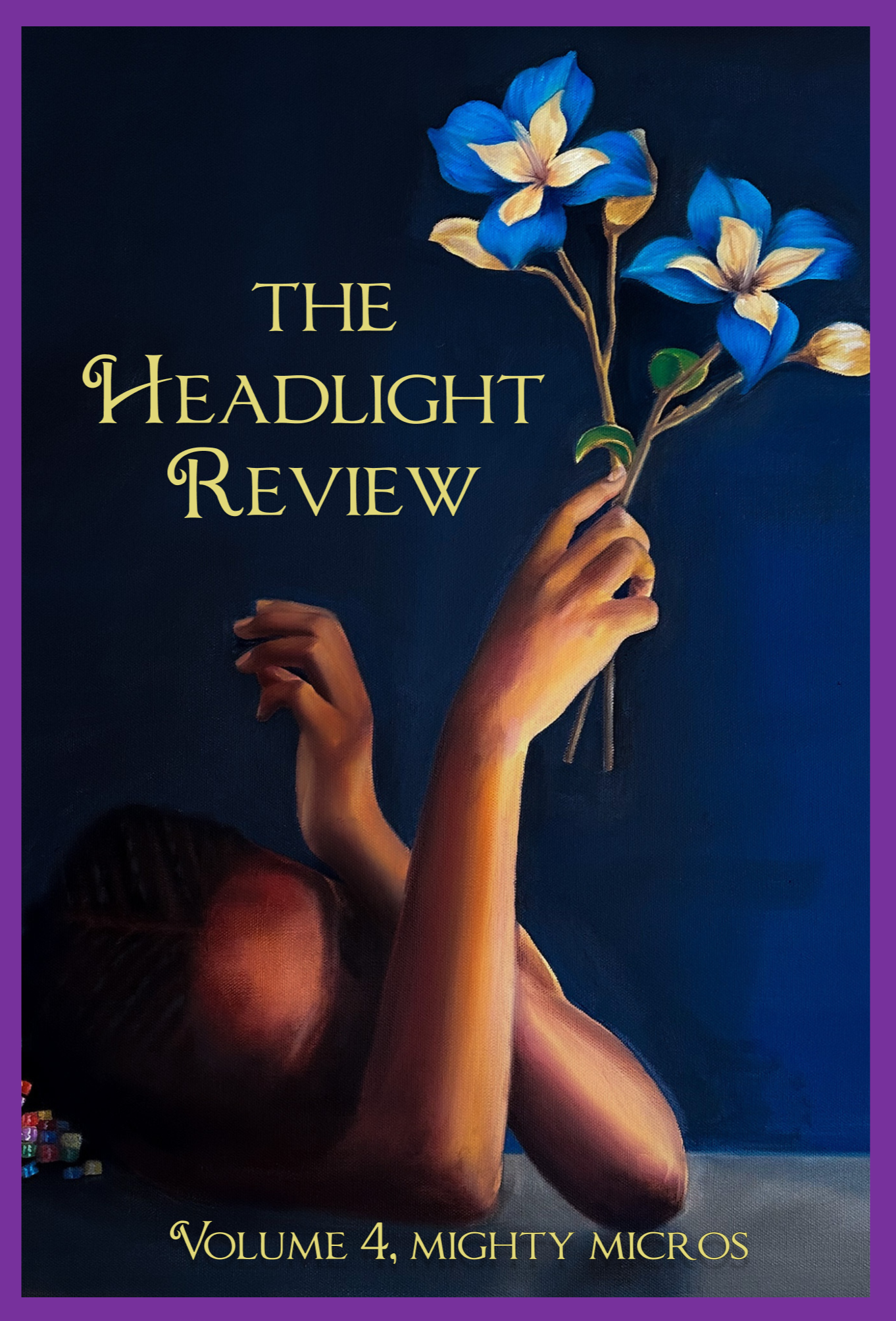
This piece was featured in Volume 4. Click here to explore other pieces from this issue.
Braids and the Meaning of Life
As a child, I was in awe of girls with braids. Girls whose hair was set in strictures like Sunday sermons.
As a child, I was in awe of girls with braids. Girls whose hair was set in strictures like Sunday sermons. I saw how hair could be parted in one quick stroke, the sharp bite of the comb moving down the scalp. How their braids lay thick as whips along their back. Even the coarsest hair could be mastered with toothy combs and tubes of gel. But I was a strubbly child. My hair stood out, defiant, headstrong. Uncontainable. I kept trying to learn the art of braiding with my dolly, twisting and turning two clumps of hair around each other―but I could never form a braid until I watched my friend’s mother separate her hair into three equal strands I could follow as they took turns winding over and under each other. So much of life, I found, is composed of three, like the primary states of matter. Even the pole star, it seems, is really three stars in one. Not to mention the three-person God I tried to divine at school. That strange family of men. Is it some stubbornness that makes me need a third proposition to defy life’s Either/Or? A theory like a braid, whose even coils I longed to feel, twining down the center of my back.
This piece was featured in Volume 4. Click here to explore other pieces from this issue.
Invocation
Kingsessing in Southwest Philadelphia is a low country of porches and brick. A long green edge where Cobbs Creek keeps the seasons and the city sets its weight down
Kingsessing in Southwest Philadelphia is a low country of porches and brick. A long green edge where Cobbs Creek keeps the seasons and the city sets its weight down. It is trolley bells and bus sighs, damp cellar air, snow that turns the street into a white ledger and summer that writes itself in hydrants. It is rowhouse cornices and hand-painted signs and the iron geometry of fire escapes. It is the smell of bread at dawn and hot brake pads at noon and rain lifting the dust off asphalt in the evening. Kingsessing is corner glass and barber mirrors, a library cool as a sanctuary, a ball thudding on varnished wood, a church basement that knows fifty recipes for mercy. It is stoops—the first step, the second step, the last—with chairs set out like commandments and gossip folded small as a prayer. It is aunties with sun hats and boys with scabbed knees and girls with jump ropes thwacking time. It is names printed on envelopes and on shirts and on the backs of jerseys, and it is the other names, the ones you earn: Ms., Coach, Cuz, Deacon, Nurse. It is the slow code of nods on a morning sidewalk. It is the place under the El where the pigeons keep their own parliament. It is a crossing guard’s raised palm and a bus kneeling and a driver who waits longer than he has to. Kingsessing is a rulebook and a rumor and a promise made on the corner; it is a notice taped to a door and a hand that takes the tape down. It is rent due, and it is someone sliding an envelope across a table, and it is thanks left like change on the table. It is the long light on Baltimore Avenue and the straight run of 52nd where commerce speaks in neon, with half the letters missing. And Kingsessing is its people, which is to say it is the sound they make together when a siren passes and no one you love is in it. It is the patience at a red light when the street is empty. It is the small work of keeping: a sweep, a saltshaker, a knock, a name. It is a neighborhood that outlasts its weather, and it is the weather that teaches the neighborhood how.
This piece was featured in Volume 4. Click here to explore other pieces from this issue.
When the Veil is Open
You can’t find morels without your father’s eye trawling the deadwood and bramble for you. Thrashers thrash in the canopy, busking their duplicitous song while chipmunk and squirrel weasel through foliage, striped firecrackers.
Before the web, there was the web of connection, no endless moving trains of news, global distractions, or any sounds all day and night. I remember the silent wind with my mate at age nine on bicycles along Suffolk roads between house paths, on country tractor paths, mooing at dairy cows we passed. I looped a plastic sack around handlebars with two potato-crisp sandwiches, prawn cocktail flavour, crushed well between caked-bread slices, with a Cadbury Flake for afters. I didn’t know what a spirit was, a duppy, or any spirit at Salvation Army or Cub Scout meetings, as I do now. Wondering if King Solomon did enough to imprison the demons and gins. In a house, a darkened room packed with friends and family, dutty-wine-dancing, filled with gin and rum, while us kids were distant, checked in and out of the coat room. Did the lovers rock, heavy reggae bass-tones, the grown-folk groove, tear the veil as Gnawa Guembri to those beyond? If I discerned enough—could I see wandering duppies bring us closer, tighter as the drink-mix loosened bones within. Each soul here, hips and groin, gyrated with deep-dropping bass and drumbeats, dripping skin with sweat. Bodies open and release in the beguiled state, my breath empty. I wonder which crows or blackbirds were watching us back then, hidden in the darkness beyond our windows or in the morning blazing sun. Ancestors on power wires, brick pub corners, or the magpies in my yard, presently watching me as I see them. Ancestors appear more in the Spring, collecting souls, bargaining lost hope broken-glass with the gins, not during the stale-tree stick-life loneliness of Winter. Maybe that’s why there is so much silence in the palatinate forest, before buds open, sails of swishing leaves begin, before the woodpecker is pecking a new home, or releasing Morse code warning to those awakening in their seasonal rebirth. This woodland place where webs were frosted statues, thawing out their connection to each beech tree, oak tree, without the noise humans created, recalling the stillness where we once played, where we once began.
This piece was featured in Volume 4. Click here to explore other pieces from this issue.