The Lost Fort

This essay is part of The Headlight Review’s series, “Southern Scrapbook,” edited by Sarah Shamaya. This series features authors who articulate how their Southern experiences influece their writing. It is our love for the South and the authors who give the South a voice that drives this endeavor.
We hope to continue publishing pieces in “The Southern Scrapbook.” Any writer interested in participating may contact THR with a pitch, or we’ll be glad to look over a submission in its entirety.
Word count: 1500 or thereabouts. Multi-media essays are encouraged.
I grew up in different wedges of a small North Georgia town. We were poor and nomadic at the narrowest possible scale. Most of that time, my family lived near a sign that commemorated the historical site of Fort Buffington. For a year, we rented a house directly across the street from the sign, while dense pines gathered at our backs. The sign is burned into my memory. The community of Buffington is a place named after one of the Cherokee removal forts used in preparation of the Trail of Tears.
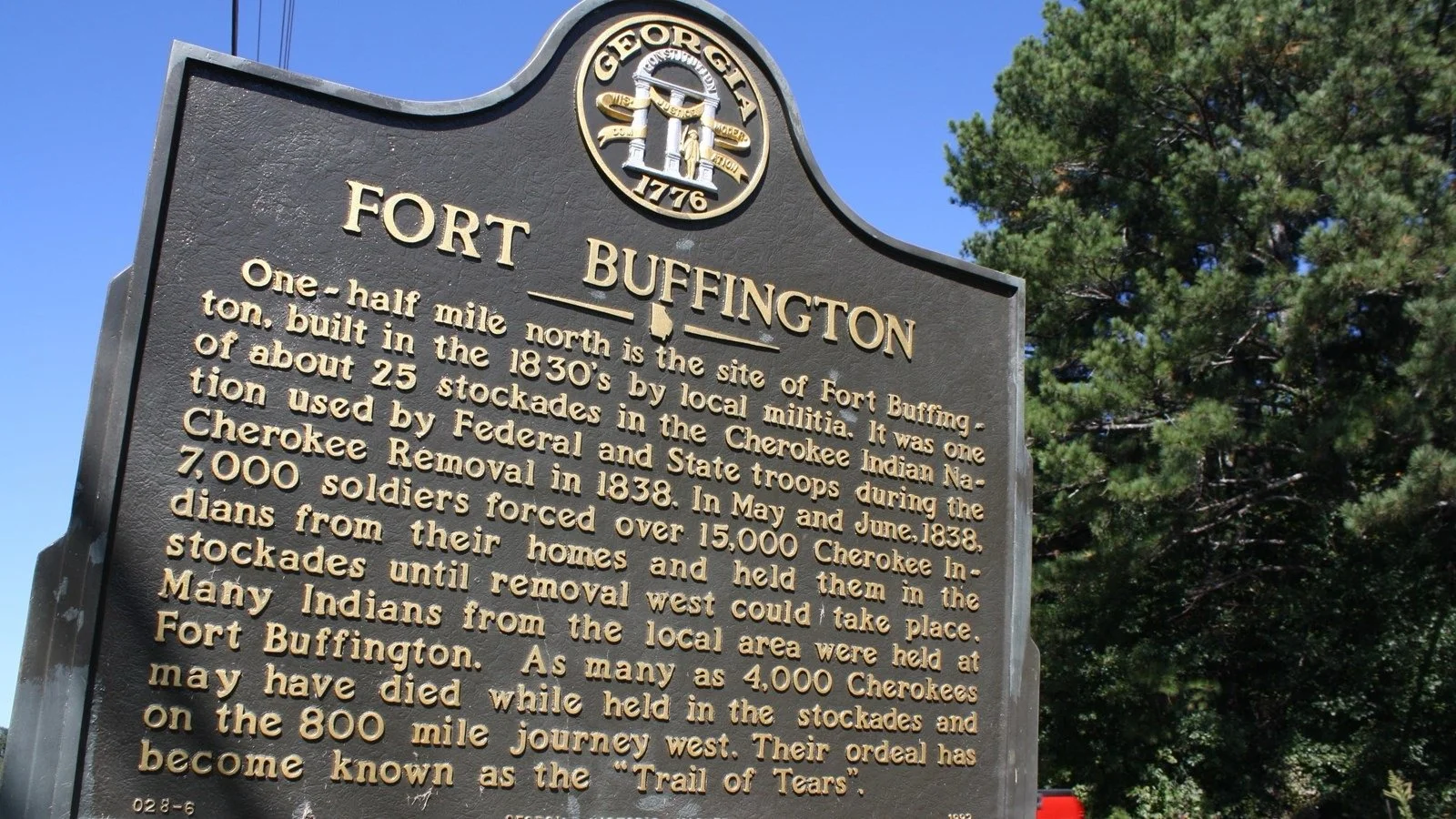
“The sign is burned into my memory.”
Coming of age in a rural (as opposed to colonial in the plantation sense) area that was probably ninety-nine percent white, with its history largely told in the same shade, the Cherokee removal would become my first real education on racial atrocities.
Slavery and the Civil War were just things in books; we did this, it was wrong, we moved on from it (so the story went). The Trail of Tears was in books, too, of course, but real evidence of it existed tangibly around me. As a child, I started to wonder why the names of places—streets, rivers, high schools—were not white, but all of us were. The tacit explanation was that the Trail of Tears was a sad sliver of history, but it was necessary and gentle, in its way. I still marvel at the tone of those conversations.
Once, my fifth-grade class took a field trip to the Etowah Indian Mounds thirty miles to the east, a gorgeous, powerfully ethereal burial site that has never entirely left my thoughts. I’ve come to realize that those mounds are another weighty symbol of my heritage—it’s not difficult to see the dark resonance of ethnic cleansing being buried in a place of burial. Because nothing on that trip was designed to teach us the depths of horror and to never aspire to it. The Georgia I grew up in might not have whitewashed the past in a formal or declarative sense, but many of the social constructs within its borders have long fed the forgetting machine.
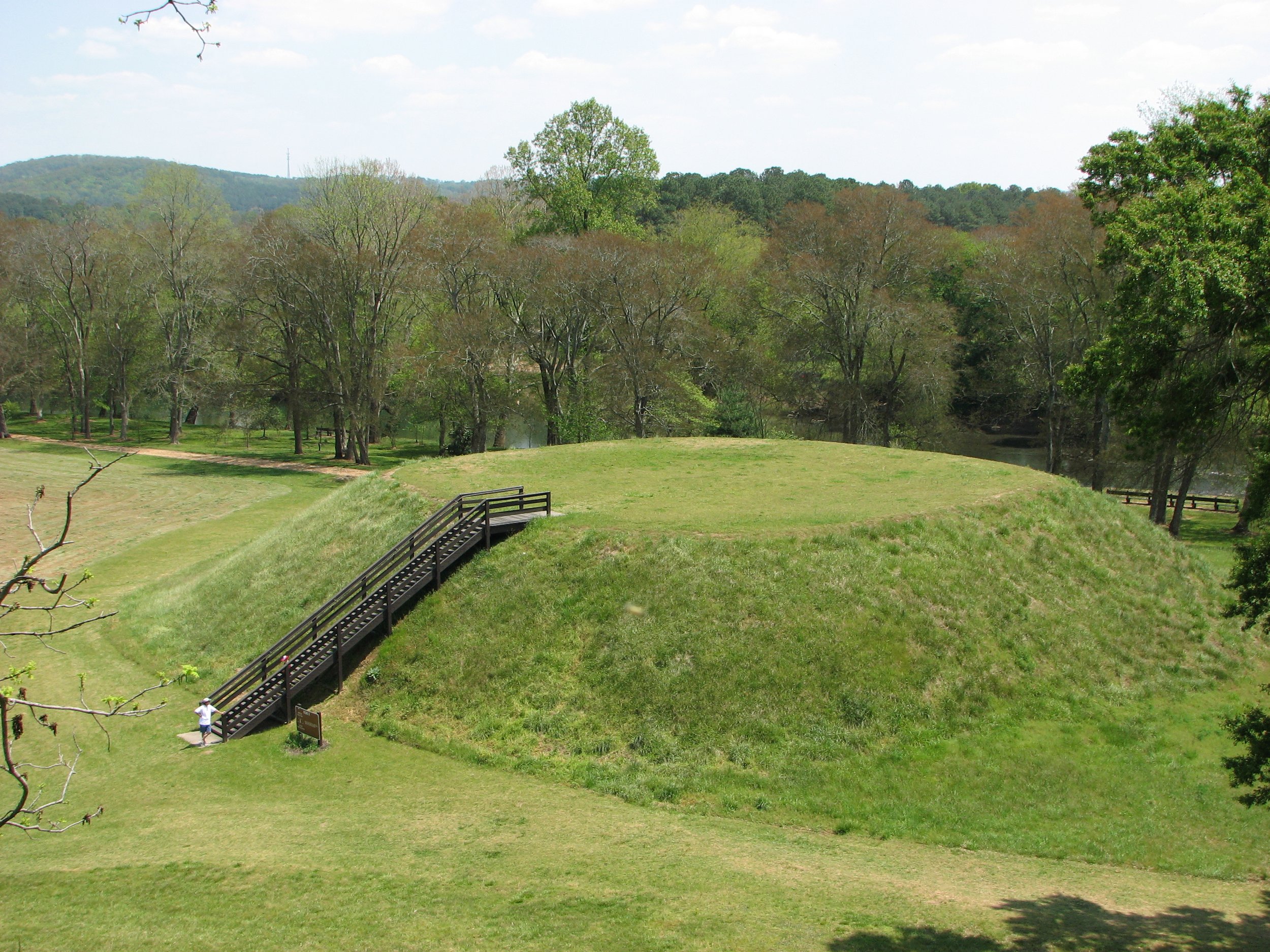
Etowah Indian Mounds Photo credit: Kåre Thor Olsen
When we look back at who we were, it’s not only in simple nostalgia. We are trying to do two intertwined things: speak to our old selves and listen to what they have to say to us. I had a good, simple upbringing, though it was sheltered. Like many white boys in rural North Georgia, it took a long while to see the scope of the whole country and its history. Sadly, some never do. It might seem strange, but I still have some trouble reading about the mistreatment of the Cherokee people and the Creek before them. I think I’m still that little boy in this regard. The difference today is that I try to listen to those voices.
No one knows where exactly Fort Buffington stood. The sign tells us it was a half mile north. I have walked around the approximate location, the trees and dirt and houses just like the other trees and dirt and houses. There is nothing to offer a clue. And thanks to a major widening of the main road over the last few years, it’s possible no one will ever know, which makes the fort even more of a ghost haunting my childhood.
This ghost and that little boy groan and rattle their chains across my work as well. It is unthinkable that they would not. I write literary horror fiction, often Southern in tone and texture, and horror is a container just waiting to be filled with evils in all their forms. It is notably a mirror to hold up to ourselves. And we should remember to examine the landscape around us in the reflection, too. What does it mean when the very location of a horror is lost? What does it mean when we accept that quietly? The writer in me will always try to figure this out. To write is to draw a map of a place and to sketch the secret hearts of the people who are there, which, at its best, can be nobler than planting a commemorative sign that gives us the excuse to feel closure and forget. To write is to dig deep, to reveal and not hide. To carry a shovel as well as a pen.
As a white author, I feel an obligation to speak only from my perspective, to write about painful, tragic circumstances through the privileged lens I was born with. The fort and its personal associations push through the membrane in much of what I write. In my novella Everything Is Beautiful and Nothing Bad Can Ever Happen Here, a white Southern protagonist is forced to confront her own complicity and the pleasant life it affords as she contends with a spouse who secretly commits white supremacist crimes.
In a more oblique way, my short story “October Film Haunt: Under the House” involves a hidden sign showing a group of film enthusiasts where the site of a beloved and dangerous movie was shot, a “location of a horror” that has been lost. Here, I believe the fort’s sign itself nudged its way out and onto paper. Somewhere between these levels of obviousness is my second novel, Nightjars, in which a strange sort of vampire corrupts the North Georgia Appalachians, the creature’s life extending back to a time where it was a part of colonization.
In the end, the Fort Buffington inside me has the loudest voice of all. My eventual education was transformative and has rippled out through so many of my words, an ugly, undeniable stone dropped into what should never have been a tranquil pond. The fort’s sign is never far from my mind, and it has stood there as a beacon and as a dividing line across my experience as an author, marking the before and the after. As a guidepost, too: Is my story taking the easy road, avoiding the Southern history I belong to, as well as the way it lives on in our world? Is everything really beautiful, and is it really true that nothing bad can ever happen here? Or am I letting the story point my way to hard questions and sentences that might need me to get dirt under my fingernails?
In my 2014 short story “Bookends,” Paul’s young wife, a Black woman named Annie, has died during childbirth, and Paul, a white man, is left haunted both by the cicadas that spend their lives in the rich soil and by his mother’s disapproval of his marriage. As I brought to life Paul’s struggles with these losses, I felt that my hands were digging farther into the dirt of life than they had before. It took longer than usual to get the dirt out from under my nails.
In a more telling example from my novel Nightjars, I removed an epistolary aside in which a woman, the granddaughter of a Cherokee couple forced to walk the Trail of Tears all the way to Oklahoma, shared some family lore with an amateur historian; though illuminating, my editor and I decided together that it was neither my story to tell nor to braid with supernatural elements. Instead, I hope the subtext shines through in my setting and that my words ring with some truth.
The place where I grew up is mostly gone, buried under countless facelifts. The population has doubled and doubled and doubled again. There was a history buff named Larry Vogt who raced the clock to find the precise site of Fort Buffington before the Georgia Department of Transportation widened Highway 20 from two lanes to six. I believe he lost that race to time and the march of industry, but I still think of him and wish him luck in his search.
These days, of course, the community of Buffington, like the city of Canton and the wider county of Cherokee (there’s that false honorarium again), is more suburban than rural. The Appalachians still hunker just north. They’re some of the oldest mountains on Earth, gorgeous but worn down by relentless age, laid out on our horizon like a line God traced with a shaky hand. You can see them clearly in the distance as you leave Interstate 575 at exit 19, though a haze of memory nearly always surrounds them.
Atlanta has sprawled north to Canton, and its slow expansion doesn’t have far to go before it runs up against the wild barrier of those mountains. In the meantime, even if the fort remains physically lost, I can only hope that with more diversity and with more honesty, future little boys in Buffington will have clearer eyes, even as they feel the tug of more ancient, peaceful history from the Blue Ridge peaks above them.
For more information about Michael Wehunt and his fiction, click here.